Support our educational content for free when you purchase through links on our site. Learn more
🏁 Ultimate Drone Racing Equipment Guide: Build, Fly, Win (2026)

Ever watched a drone slice through a neon gate at 80 mph, the pilot’s eyes glued to a tiny screen, and wondered how on earth they don’t crash? It looks like magic, but it’s actually a high-stakes game of physics, soldering, and split-second reflexes. At Drone Brands™, we’ve spent countless hours in the pit lane, watching pros turn $50 builds into championship winners and beginners turn their first $20 drone into a pile of carbon fiber confetti. The secret isn’t just buying the most expensive gear; it’s knowing exactly which drone racing equipment fits your skill level and your budget.
In this comprehensive guide, we’re stripping away the jargon to reveal the truth about FPV racing gear. We’ll walk you through the critical choice between analog and digital systems, explain why your 6S battery matters more than your frame, and share the one tool that saved our entire season after a catastrophic crash. Whether you are looking to build your first 5-inch racer from scratch or upgrade your rig for the next MultiGP championship, we’ve got the insights you need. By the end of this article, you’ll know exactly how to avoid the rookie mistakes that cost us thousands of dollars and hours of frustration.
Key Takeaways
- Analog vs. Digital: Choose analog systems for competitive racing due to near-zero latency, while digital systems (like DJI O3) are superior for learning and cinematic frestyle.
- The 5-Inch Standard: The 5-inch frame remains the gold standard for racing, offering the perfect balance of speed, agility, and parts availability.
- Safety First: Never compromise on LiPo safety; always use a LiPo-safe bag and inspect batteries for swelling before every single flight.
- Simulator Training: Mastering the FPV simulator is the single most cost-effective investment you can make before touching a real drone.
- Community Matters: Joing a local MultiGP chapter provides access to structured racing, insurance, and a supportive network of experienced pilots.
👉 Shop Top Categories:
- FPV Racing Drones: Amazon | GetFPV
- FPV Goggles: Amazon | DJI Official
- Radio Controllers: Amazon | RadioMaster Official
Table of Contents
- ⚡️ Quick Tips and Facts
- 📜 From Hobbyist Halls to High-Speed Circuits: A Brief History of Drone Racing Gear
- 🚁 The Core Machine: Selecting Your First FPV Racing Drone Frame
- 🔋 Powering the Beast: Understanding Motors, ESCs, and Battery Tech
- 👓 See Like a Pilot: Choosing the Right FPV Goggles and Video Transmitters
- 🎮 Mastering the Stick: Controllers, Radios, and Binding Protocols
- 🛠️ Essential Tools and Spare Parts for the Pit Crew
- 🧠 Software, Firmware, and Configuration: Betaflight and Beyond
- 🏁 Building Your First Racer: A Step-by-Step Assembly Guide
- 🛡️ Safety First: LiPo Handling, Fire Prevention, and Range Testing
- 🌍 Finding the Track: How to Join Local Clubs and Competitions
- 💡 Common Mistakes New Pilots Make (And How to Avoid Them)
- 🏆 Conclusion
- 🔗 Recommended Links
- ❓ FAQ
- 📚 Reference Links
⚡️ Quick Tips and Facts
Before you dive headfirst into the chaotic, soldering-iron-fueled world of drone racing, let’s hit the pause button and drop some hard truths that could save you hundreds of dollars (and a lot of tears).
- Analog vs. Digital: The eternal debate. Analog systems (like DJI’s old tech or Fat Shark’s legacy) offer near-zero latency and are the gold standard for competitive racing, but the video is grainy. Digital systems (DJI O3/O4, Walksnail) look like 4K cinema but introduce a tiny bit of lag. For pure speed, pros still lean analog; for fun and learning, digital is king.
- The “Bind N Fly” (BNF) Trap: Many beginners buy a drone without a radio, thinking they can just “plug and play.” Wrong. You need a radio first! If you buy a BNF drone, you must ensure it’s compatible with your radio’s protocol (usually ELRS or Crossfire).
- LiPo Safety is Non-Negotiable: A Lithium Polymer battery is essentially a small firecracker if mishandled. Never charge them unattended, and always use a LiPo-safe bag.
- The Simulator is Your Best Friend: Before you ever solder a wire or buy a prop, fly a simulator. It’s the only way to build muscle memory without turning your new drone into a pile of plastic shrapnel.
For a deeper dive into the specific mechanics of these machines, check out our comprehensive guide on FPV Drones.
📜 From Hobbyist Halls to High-Speed Circuits: A Brief History of Drone Racing Gear

It wasn’t always about carbon fiber and 5-inch props. The story of drone racing equipment begins in the early 2010s, when hobbyists started strapping GoPros to quadcopters and realizing, “Hey, this looks cool from the pilot’s perspective!”
The first “races” were messy, with pilots using modified RC car transmitters and cheap, grainy analog video transmitters (VTX) that often interfered with each other. The FPV (First Person View) revolution kicked into high gear around 2014-2015, driven by the formation of the DRL (Drone Racing League) and the MultiGP organization.
As the sport professionalized, the gear evolved rapidly:
- The Analog Era: Early racers used 5.8GHz analog video. It was cheap, fast, but prone to “snow” and interference.
- The Digital Dawn: DJI entered the scene with the Air Unit, offering HD video but at the cost of weight and latency.
- The ELRS Revolution: The rise of ExpressLRS (ELRS) protocols replaced older, clunky systems, offering incredible range and reliability for a fraction of the cost.
Today, we stand at a crossroads where hybrid racing (using digital for training, analog for competition) is common. The gear has become lighter, faster, and more modular, allowing pilots to swap parts like Lego bricks.
🚁 The Core Machine: Selecting Your First FPV Racing Drone Frame
Choosing a frame is like choosing a car chassis. Do you want a nimble hatchback or a heavy-duty truck? In the drone world, the frame dictates the size class, which determines the motors, props, and ultimately, the speed.
Size Matters: The 5-Inch Standard
For competitive racing, the 5-inch frame is the undisputed king. It offers the perfect balance of speed, agility, and durability.
- Pros: High top speed, widely available parts, standard prop size.
- Cons: Heavier than smaller classes, requires more power.
The Rising Stars: 3-Inch and 7-Inch
- 3-Inch: The new darling of the “Whop” and “Cinematic” racing scenes. Incredible agility, but less top speed.
- 7-Inch: The long-range cruiser. Great for endurance racing, but can feel sluggish in tight technical courses.
Top Frame Recommendations
We’ve tested dozens of frames in the pit lane, and these stand out:
| Frame Model | Size Class | Material | Best For | Durability Rating |
|---|---|---|---|---|
| TBS Source One V5 | 5″ | Carbon Fiber | Beginners & Pros | 9/10 |
| FIVE3 Lightswitch V2 | 5″ | Carbon Fiber | Durability & Speed | 10/10 |
| HGLRC Rekon 10 | 10″ | Carbon Fiber | Long Range / Cinematic | 8/10 |
| iFlight Nazgul Evoque | 5″ | Carbon Fiber | All-Rounder | 9/10 |
Why the TBS Source One? It’s the “Toyota Corolla” of the drone world. It’s cheap, parts are everywhere, and it can take a beating. If you crash (and you will), you won’t cry over a $30 frame.
Why the FIVE3 Lightswitch? This frame is a favorite among pro pilots. The unique “switchback” design allows for easy motor replacement without removing the arms, and the carbon fiber thickness is optimized for rigidity.
Pro Tip: Look for stacked or separated flight controller (FC) and ESC (Electronic Speed Controller) mounts. Separated mounts reduce vibration interference, leading to smoother flight.
👉 Shop Frames on:
- TBS Source One V5: Amazon | GetFPV | RaceDayQuads
- FIVE3 Lightswitch V2: Amazon | FIVE3 Official
🔋 Powering the Beast: Understanding Motors, ESCs, and Battery Tech
If the frame is the body, the motors and ESCs are the heart and lungs. This is where the magic happens.
Motors: The KV Rating Conundrum
The KV rating tells you how many RPMs the motor spins per volt.
- High KV (e.g., 240KV): Spins fast, great for 4S batteries, less torque. Good for tight, technical tracks.
- Low KV (e.g., 170KV): Spins slower, more torque, better for 6S batteries. Great for high-speed, open courses.
The 6S vs. 4S Debate:
- 4S: The traditional racing standard. Lighter, faster acceleration, but less top-end speed.
- 6S: The modern trend. Higher voltage means more efficiency and smoother power delivery. Most pro racers have switched to 6S.
ESCs: The Brain of the Power
The ESC converts battery power into the precise pulses needed to spin the motors.
- Blheli_S: The standard firmware for most racing ESCs. Reliable and tunable.
- AM32: A newer, open-source firmware gaining traction for its superior performance and features.
Battery Tech: LiPo is King
You cannot run a racing drone on standard Li-ion batteries. You need LiPo (Lithium Polymer) batteries.
- C-Rating: Indicates how fast the battery can discharge. For racing, you want 10C or higher.
- Capacity: Measured in mAh. 130mAh is standard for 5-inch 6S.
Recommended Motor/ESC Combos:
- Budget King: EMAX Eco II 207 motors paired with a Holybro Durandal stack.
- Pro Choice: T-MOTOR F72 stack with F5A Pro II ESCs.
Did you know? A single crash can destroy a motor. Always carry spare props and motors in your flight bag.
👉 Shop Motors & ESCs on:
- T-Motor MN 7 HD: Amazon | T-Motor Official
- EMAX Eco II 207: Amazon | EMAX Official
👓 See Like a Pilot: Choosing the Right FPV Goggles and Video Transmitters
This is the most critical piece of equipment. If you can’t see, you can’t fly. The choice between Analog and Digital goggles is the first major fork in the road.
Analog Goggles
- Pros: Ultra-low latency (critical for racing), cheaper, lighter.
- Cons: Grainy video, prone to interference (“snow”).
- Top Pick: Fat Shark HDO2 or Skyzone Cobra X. These are the industry standards for a reason.
Digital Goggles
- Pros: Crystal clear HD video, easier to learn on, less eye strain.
- Cons: Slight latency (10-20ms), heavier, more expensive.
- Top Pick: DJI Goggles 2 or Walksnail Avatar Goggles.
The Video Transmitter (VTX)
Your drone needs to send the video to your goggles.
- Analog VTX: 25mW to 80mW. Higher power = longer range but more heat.
- Digital Units: DJI O3/O4 Air Unit, Walksnail Avatar. These are all-in-one camera and transmitter units.
Comparison Table: Analog vs. Digital for Racing
| Feature | Analog System | Digital System (DJI/Walksnail) |
|---|---|---|
| Latency | < 5ms (Instant) | 15-30ms (Slight delay) |
| Video Quality | Grainy, 480p | HD, 720p/1080p |
| Cost | Low ($50-$10) | High ($30+) |
| Interference | High (Snow/Static) | Low (Digital noise) |
| Best For | Competitive Racing | Learning & Frestyle |
The Verdict: If you are training for a MultiGP or DRL race, you must fly analog. The latency difference is the difference between winning and crashing into a gate. If you are just having fun, go digital.
👉 Shop Goggles on:
- Fat Shark HDO2: Amazon | FatShark Official
- DJI Goggles 2: Amazon | DJI Official
🎮 Mastering the Stick: Controllers, Radios, and Binding Protocols
Your radio is your lifeline. A bad radio can mean a lost drone. The days of cheap, plastic transmitters are over.
The Protocol Wars: ELRS vs. Crossfire
- ELRS (ExpressLRS): The new open-source standard. Incredible range, low latency, and free. It’s the choice of 90% of new pilots.
- Crossfire (TBS): The previous pro standard. Still excellent, but requires a paid module.
- FrSky: The old standard. Avoid for racing; it has higher latency and range issues.
Top Radio Recommendations
- RadioMaster TX16S MKII: The Swiss Army Knife. Full-size, supports all protocols, huge screen.
- Radiomaster Pocket: The budget king. Tiny, lightweight, but powerful. Perfect for travel.
- Jumper T-Lite: A solid mid-range option with a great feel.
Binding Your Drone:
Most modern drones use ELRS. You simply hold the “Bind” button on the drone and the “Bind” button on the radio, and they pair instantly. No complex codes needed.
Pro Tip: Always carry a USB-C cable and a backup battery for your radio. Running out of power mid-race is a rookie mistake.
👉 Shop Radios on:
- RadioMaster TX16S: Amazon | RadioMaster Official
- Radiomaster Pocket: Amazon | RadioMaster Official
🛠️ Essential Tools and Spare Parts for the Pit Crew
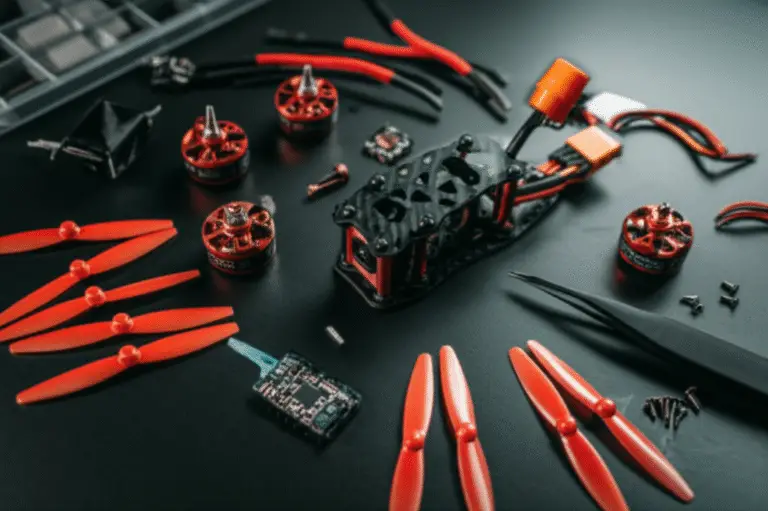
You think you’re ready to race? You’re not. You need a pit kit. A crash is inevitable. The difference between a 5-minute fix and a DNF (Did Not Finish) is your tool kit.
The Must-Have Toolkit
- Hex Drivers: M2, M2.5, and M3 sizes. Get magnetic ones to prevent losing screws.
- Soldering Iron: A temperature-controlled iron (like TS10 or Pinecil) is essential for repairs.
- Wire Cuters & Strippers: For fixing broken motor wires.
- Zip Ties & Heat Shrink: The duct tape of the drone world.
- Propeller Puller: To safely remove stuck props.
The “Crash Kit” Spares
- Props: At least 3 sets of 5-inch props (3-blade and 4-blade).
- Motors: One spare motor per arm (or at least two).
- Camera: A spare analog camera or a digital unit.
- Battery: A spare LiPo battery.
Anecdote: I once saw a pilot win a race because he had a spare motor in his pocket. The other pilot spent 20 minutes trying to fix a broken arm with duct tape. Be the guy with the spare parts.
👉 Shop Tools on:
- TS10 Soldering Iron: Amazon | Pinecil Official
- Hex Driver Set: Amazon
🧠 Software, Firmware, and Configuration: Betaflight and Beyond
Hardware is only half the battle. The firmware is the soul of your drone. Betaflight is the industry standard for racing drones.
What is Betaflight?
It’s the open-source flight controller software that allows you to tune your drone’s PID (Proportional, Integral, Derivative) values.
- PID Tuning: Adjusts how the drone reacts to inputs. Too sensitive = shaky. Too loose = sluggish.
- Filters: Removes noise from the gyro to make the flight smoother.
Configuration Steps
- Flash Firmware: Use the Betaflight Configurator to update your FC.
- Set Modes: Assign “Arm,” “Angle,” and “Bep” to your radio switches.
- Tune PIDs: Start with the default “Auto-PID” and adjust based on flight logs.
- Blackbox Logging: Enable this to record flight data. It’s crucial for diagnosing crashes.
Warning: Never fly without testing your failsafe. If you lose signal, the drone should land or return home, not fly away into the sunset.
Learn More:
🏁 Building Your First Racer: A Step-by-Step Assembly Guide
Ready to build? Let’s walk through the process. This is where the magic happens.
Step 1: Frame Assembly
Start with the carbon fiber plates. Stack them in the correct order (usually FC on top, ESC on bottom). Use nylon standoffs to keep metal away from electronics.
Step 2: Soldering the Power System
- Solder the XT60 connector to the ESC power pads.
- Solder the capacitor (if included) to reduce voltage spikes.
- Crucial: Ensure polarity is correct! Red to positive, black to negative.
Step 3: Mounting Motors and ESC
- Mount the motors to the arms.
- Solder the motor wires to the ESC pads. Order matters! If the motor spins backward, swap any two wires.
Step 4: Flight Controller and VTX
- Mount the FC and VTX.
- Connect the UART wires for the receiver and VTX.
- Connect the camera to the FC video input.
Step 5: Final Assembly and Testing
- Install the props (carefully!).
- Connect the battery.
- Open Betaflight Configurator and check if all motors spin in the correct direction.
Pro Tip: Use silicone wire for power connections. It’s flexible and handles high current better than standard wire.
Watch the Process:
For a visual guide, check out the “First YouTube Video” perspective on this topic, where the creator discusses the fast-paced nature of the industry and the importance of following pro builds.
🛡️ Safety First: LiPo Handling, Fire Prevention, and Range Testing
Safety is not a suggestion; it’s a rule. A LiPo fire can destroy your car, your house, and your reputation.
LiPo Safety Rules
- Never charge unattended.
- Use a LiPo-safe bag.
- Inspect batteries for swelling or damage before every flight.
- Store in a fireproof container when not in use.
Range Testing
Before you fly a new drone, do a range test.
- Fly to a safe distance.
- Check for video dropouts.
- Ensure the failsafe works (pull the antenna out or turn off the radio).
Propeller Safety
Props are razor blades. Always remove them when working on the drone. A spinning prop can cause severe injury.
Did you know? The FAI (Fédération Aéronautique Internationale) has strict safety guidelines for drone racing. Always check local regulations before flying.
Learn More:
🌍 Finding the Track: How to Join Local Clubs and Competitions
You’ve built your drone, you’ve practiced in the simulator, and you’re ready to race. Where do you go?
Join MultiGP
MultiGP is the largest drone racing organization in the world. They have chapters everywhere.
- Benefits: Structured races, insurance, and a community of pilots.
- How to Join: Find a local chapter on the MultiGP website.
Local Clubs
Many areas have independent clubs. They often host “open fly” days where you can try out different tracks.
Competitions
- DRL (Drone Racing League): The “Formula 1” of drone racing. High production value, pro pilots.
- MultiGP World Championships: The ultimate test of skill.
Pro Tip: Don’t be afraid to ask for help. The drone community is incredibly welcoming. Most pilots will help you fix your drone for free.
Find a Club:
💡 Common Mistakes New Pilots Make (And How to Avoid Them)
We’ve all been there. Here are the pitfalls to avoid:
- Skipping the Simulator: This is the #1 mistake. You will crash your real drone. Fly the sim first.
- Ignoring Battery Health: Swollen LiPos are dangerous. Check them every time.
- Wrong Prop Size: Using 5-inch props on a 3-inch frame (or vice versa) will destroy your motors.
- Poor Soldering: Cold joints cause intermittent failures. Learn to solder properly.
- Not Tuning PIDs: A poorly tuned drone is hard to fly. Take the time to tune.
The Golden Rule: Respect the drone. It’s a machine, not a toy. Treat it with care, and it will reward you with incredible flights.
Recommended Resources:
🏆 Conclusion

So, you’ve made it to the end. You know the difference between a 5-inch frame and a 7-inch beast, you understand why ELRS is the future, and you know that LiPo safety is non-negotiable.
The journey from a curious hobbyist to a competitive drone racer is filled with crashes, burnt motors, and late-night soldering sessions. But the feeling of flying through a gate at 80 mph, seeing the world through the eyes of a machine, is unmatched.
Our Final Recommendation:
If you are a beginner, start with a simulator and a budget analog setup (like a TBS Source One frame with EMAX motors). It’s cheap, durable, and teaches you the fundamentals. Once you’ve mastered the basics, upgrade to a 6S digital system for a more immersive experience.
Remember, the best gear is the gear you know how to use. Don’t get caught up in the hype. Build, fly, crash, fix, repeat. That’s the drone racing life.
Ready to take flight? Check out our FPV Drones guide for more detailed reviews and buying advice.
🔗 Recommended Links
👉 Shop Top Racing Gear:
- TBS Source One V5 Frame: Amazon | GetFPV | RaceDayQuads
- RadioMaster TX16S Radio: Amazon | RadioMaster Official
- DJI Goggles 2: Amazon | DJI Official
- EMAX Eco II 207 Motors: Amazon | EMAX Official
Books & Guides:
Community & Organizations:
❓ FAQ

Where can I buy affordable drone racing parts and accessories?
You can find affordable parts at GetFPV, RaceDayQuads, and Amazon. Look for “budget” or “entry-level” lines from brands like EMAX, TBS, and BetaFPV. These retailers often have sales and bundles that save you money.
What safety gear is recommended for drone racing pilots?
Essential safety gear includes LiPo-safe bags, fire extinguishers (Class D for metal fires), safety glasses, and gloves for handling hot components. Always wear eye protection when soldering or flying.
Read more about “🚀 85,0+ FAA Drone Stats: The 2026 Sky Report You Need”
How do drone racing transmitters work?
Transmitters send radio signals to the drone’s receiver. The receiver interprets these signals and adjusts the motor speeds via the ESC. Modern systems use 2.4GHz or 90MHz frequencies for better range and penetration.
Read more about “Mastering Long Range Drone Transmission: Top 10 Systems in 2025 🚀”
What upgrades improve drone racing performance the most?
The biggest performance upgrades are lighter batteries, higher KV motors, and better propellers. Upgrading to a digital video system can also improve visibility, though it adds weight.
Read more about “📈 Drone Statistics Graph: The Sky-High Data You Need (2026)”
What type of drone is best for racing competitions?
The 5-inch 6S analog drone is the standard for competitive racing. It offers the best balance of speed, agility, and durability.
Read more about “Can I Make Money with Drone Racing and Aerial Sports Events? 💸 (2026)”
How do I choose the best drone racing goggles?
Choose analog goggles for competitive racing (low latency) and digital goggles for learning and frestyle (HD video). Consider Fat Shark for analog and DJI for digital.
Read more about “FPV Drones Unleashed: 15 Must-Know Facts & Top Picks (2026) 🚁”
What are the essential drone racing equipment for beginners?
Beginers need a simulator, a radio, a BNF drone, goggles, and a LiPo charger. Start with a budget setup to learn the ropes.
Read more about “🚀 Best FPV Drone for Beginners (2026): 8 Budget Bundles Revealed”
How much does a complete drone racing kit cost?
A complete beginner kit can range from $40 to $80, depending on whether you choose analog or digital. Pro-level kits can exceed $1,50.
Read more about “🚁 Best Drones of 2026: Top 5 Picks for Every Pilot”
What FPV goggles are best for drone racing?
Fat Shark HDO2 is the top choice for analog racing. DJI Goggles 2 is the top choice for digital racing.
Read more about “Are There Any Drone Brands Specialized in Racing Drones? 🏁 (2025)”
Which drone racing motors offer the best performance?
T-MOTOR and EMAX offer top-tier motors. The T-MOTOR MN 7 and EMAX Eco II are popular choices for their durability and power.
Read more about “🚀 10 Essential FPV Drone Maintenance & Upgrade Tips (2026)”
How do I choose the right frame for drone racing?
Choose a 5-inch frame for racing. Look for carbon fiber construction and modular design for easy repairs.
Read more about “Top 12 Quadcopter FPV Systems to Elevate Your Flight in 2025 🚁”
What are the best drone racing controllers for pros?
RadioMaster TX16S and Jumper T-Lite are favorites among pros for their reliability and feature sets.
Read more about “🚀 How to Choose the Right FPV Drone: The 2026 Ultimate Guide”
Do I need special batteries for competitive drone racing?
Yes, you need LiPo batteries with a high C-rating (10C+) and the correct voltage (4S or 6S) for your motors.
📚 Reference Links