Support our educational content for free when you purchase through links on our site. Learn more
Real-Time VR Drone Broadcasting for Extreme Sports 🚁

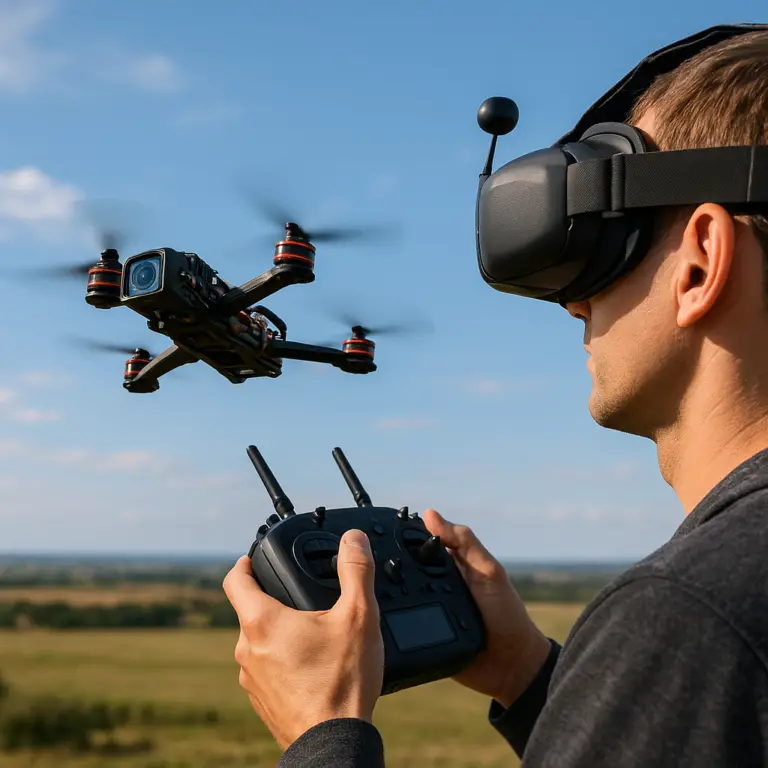
Real-time VR drone broadcasting for extreme sports events works best as a hybrid system: use agile FPV drones for thrilling pursuit shots, stabilized camera drones for context, and 360-degree capture for immersive spectator control. Add low-latency networking, redundant video links, qualified pilots, and a conventional backup feed, and you have a broadcast that feels dramatic without becoming technically reckless.
We learned that lesson while filming a downhill mountain-bike run. The FPV drone skimed through the trees beside the rider, but the wide stabilized shot revealed the sheer drop beyond the trail. One camera delivered the adrenaline; the other explained why everyone watching suddenly stopped breathing.
That balance matters because the fastest drone is not automatically the best broadcast camera. The Drone Racing League has showcased aircraft reaching roughly 90 mph, while its record-setting RacerX reached 163.5 mph under specific record conditions, according to ASME. Most event producers need something more useful than headline speed: stable video, low latency, safe flight paths, readable telemetry, and a viewing experience that does not make headset users feel seasick.
A successful production may combine FPV racing drones, DJI Inspire 3 or Matrice platforms, GoPro or Insta360 cameras, 5G or private LTE, edge encoding, live graphics, and VR delivery through headsets, mobile devices, smart TVs, and web players. The result can put viewers inside a race, beside a cliff jumper, above a whitewater rapid, or directly behind a downhill rider.
Key Takeaways
- Use a hybrid camera strategy: FPV drones create speed and intimacy, while stabilized drones and ground cameras provide course context and reliable backup coverage.
- Prioritize low latency and redundancy: Separate aircraft-control links from audience streaming links, and maintain backup feeds, local recording, and alternate network paths.
- Choose the VR format carefully: Live FPV, 360-degree video, stereoscopic VR, and volumetric replays serve different audiences and production goals.
- Plan safety before spectacle: FAA rules, Remote ID, airspace authorization, visual observers, exclusion zones, weather limits, and emergency procedures are essential for live sports.
- Treat networking as part of the flight system: Dedicated RF, 5G, private LTE, bonded cellular, satellite, and edge computing can support professional coverage when tested in the actual venue.
- Do not rely one aircraft: A backup drone, conventional camera angle, spare batteries, and failover communication can save an entire event when wind, RF interference, or hardware failure appears.
- Design for viewer comfort: Stable horizons, controlled acceleration, clear camera labels, shorter FPV segments, and easy recentering make immersive coverage more enjoyable.
- Volumetric broadcasting is promising but demanding: Multi-drone systems, AI tracking, NeRF reconstruction, and free-camera replays are exciting, but they require rigorous synchronization, processing, regulation, and field testing.
- The best production tells the story, not just the stunt: The audience needs to understand the athlete, course, speed, risk, and result—not merely watch pixels move very quickly.
Table of Contents
- ⚡️ Quick Tips and Facts
- What Real-Time VR Drone Broadcasting Means
- The Essential Technology Stack at a Glance
- 🏁 From FPV Racing to Immersive Extreme Sports Coverage: The Evolution of Drone Broadcasting
- How Live Drone Video Changed Sports Production
- Why VR Headsets and 360-Degree Video Raise the Stakes
- 🎥 How Real-Time VR Drone Broadcasting Works
- Capture: FPV Cameras, 360 Cameras, and Cinematic Drone Systems
- Transmission: Low-Latency Video Links and Wireless Networks
- Processing: Encoding, Stitching, and Live Graphics
- Distribution: VR Platforms, Broadcast Trucks, and Streaming Services
- How Signal Latency Affects Viewer Immersion
- 🚁 Best Drone Platforms for Extreme Sports Events
- FPV Racing Drones for High-Speed Action
- Cinematic FPV Drones for Mountain and Urban Sports
- Enterprise Camera Drones for Stable Aerial Coverage
- 360-Degree Camera Drones for VR Spectators
- Drone-in-a-Box and Autonomous Systems for Repeated Events
- 🏆 9 Extreme Sports That Benefit Most from Live VR Drone Coverage
- 1. Drone Racing and FPV Competitions
- 2. Mountain Biking and Downhill Racing
- 3. Snowboarding, Sking, and Freride Events
- 4. Surfing, Kitesurfing, and Windsurfing
- 5. Skateboarding, BMX, and Frestyle Motocross
- 6. Rock Climbing, Base Jumping, and Wingsuit Flying
- 7. Whitewater Kayaking and Rafting
- 8. Rally, Off-Road Racing, and Desert Sports
- 9. Adventure Races and Multi-Discipline Outdoor Events
- 🥽 VR Viewing Experiences for Fans
- First-Person FPV Views Versus Broadcast-Style Camera Angles
- Live 360 VR, Volumetric Video, and Mixed-Reality Overlays
- VR Headsets, Mobile Devices, Smart TVs, and Web Players
- Interactive Camera Selection and Spectator Controls
- Reducing Motion Sickness During High-Speed Drone Feds
- 📡 Network Infrastructure for Low-Latency Live Streaming
- 5G, Private LTE, Wi-Fi 6, and Dedicated RF Links
- Satellite Connectivity for Remote Extreme Sports Locations
- Edge Computing and On-Site Video Processing
- Bandwidth Planning for Multiple Drones and VR Feds
- Redundancy, Failover, and Backup Communication Systems
- 🎬 Production Workflow for a Live Drone Sports Broadcast
- Pre-Event Scouting, Mapping, and Flight-Path Design
- Camera Coordination Between Drones, Helicopters, and Ground Crews
- Live Directing, Replay, Commentary, and On-Screen Data
- Adding Telemetry, Leaderboards, GPS Maps, and Athlete Data
- Color Grading, Audio Capture, and Immersive Sound
- 🛡️ Safety, Regulations, and Risk Management
- FAA Rules for Commercial Drone Broadcasting in the United States
- Remote ID, Part 107, Waivers, and Operations Over People
- International Drone Regulations for Global Events
- Geofencing, Airspace Coordination, and Temporary Flight Restrictions
- Protecting Athletes, Spectators, Crew, and Property
- Emergency Procedures, Lost-Link Protocols, and Recovery Plans
- 🔐 Privacy, Cybersecurity, and Content Rights
- Athlete Consent, Spectator Privacy, and Data Protection
- Securing Drone Command Links and Live Video Feds
- Copyright, Music Licensing, Sponsorships, and Broadcast Rights
- Protecting Location Data and Sensitive Event Information
- 🌦️ Weather and Environmental Challenges
- Wind, Rain, Snow, Fog, and Extreme Temperatures
- Battery Performance at High Altitude and in Cold Conditions
- Managing Glare, Low Light, Dust, and Water Spray
- Sustainable Drone Operations for Large Sporting Events
- 🧰 Equipment Checklist for Real-Time VR Drone Broadcasting
- Aircraft, Propellers, Batteries, and Charging Equipment
- FPV Gogles, VR Headsets, Monitors, and Control Stations
- Cameras, Gimbals, Encoders, Switchers, and Recording Systems
- Antennas, Signal Analyzers, Intercoms, and Network Hardware
- Spare Parts, Field Repair Tools, and On-Site Power
- 👥 Building the Professional Drone Broadcast Team
- Remote Pilots, Visual Observers, and Flight Safety Officers
- Camera Operators, VR Directors, and Broadcast Engineers
- Event Producers, Commentators, Data Operators, and Medical Staff
- Training, Certification, and Practice Requirements
- 📊 Measuring Broadcast Quality and Audience Engagement
- Latency, Resolution, Frame Rate, and Uptime
- Viewer Retention, Headset Time, and Interactive Engagement
- Sponsor Visibility, Brand Integration, and Advertising Opportunities
- Post-Event Analytics and Viewer Feedback
- 💰 Budget Planning and Event Scalability
- One-Day Local Events Versus Global Broadcast Productions
- Owned Equipment, Rental Crews, and Managed Production Services
- Scaling From a Single Drone to a Multi-Aircraft VR Network
- Hidden Costs: Permits, Insurance, Travel, Connectivity, and Contingencies
- ✅ Advantages and ❌ Limitations of Real-Time VR Drone Broadcasting
- What Drone-Based VR Does Better Than Traditional Sports Cameras
- Where Ground Cameras, Cable Cams, and Helicopters Still Win
- Common Failure Points and How Experienced Crews Prevent Them
- 🔮 The Future of Immersive Drone Sports Broadcasting
- AI-Assisted Tracking and Autonomous Camera Piloting
- 6K and 8K Live VR, HDR, and Spatial Video
- Digital Twins, Extended Reality, and Virtual Venue Experiences
- Cloud Production, 5G Broadcast, and Personalized Viewing
- 🧭 How to Plan Your Own Live VR Drone Sports Production
- Define the Audience, Sporting Objective, and Distribution Channels
- Choose the Right Drone, Camera, Network, and Crew
- Create a Flight Plan, Safety Case, and Technical Runbook
- Test the Entire Broadcast Before Event Day
- Post-Event Review and Continuous Improvement
- 💡 Quick Tips for Better FPV and VR Event Coverage
- Conclusion
- Recommended Links
- FAQ
- What Is Real-Time VR Drone Broadcasting for Extreme Sports Events?
- How Much Delay Is Acceptable for Live FPV and VR Video?
- Which Drones Are Best for Live Extreme Sports Coverage?
- Can Drone Racing Footage Be Streamed Directly to VR Headsets?
- Do Live VR Drone Flights Require Special Permits?
- How Do Broadcasters Keep Drones Safe Around Spectators?
- What Internet Connection Is Needed for Live 360-Degree Drone Video?
- Can One Pilot Operate Multiple Broadcasting Drones?
- How Can VR Drone Broadcasts Reduce Motion Sickness?
- Reference Links
Quick Tips and Facts
Our Drone Brands™ pilots have learned one hard truth: a spectacular drone feed is only half a live VR broadcast. The other half is keeping the aircraft safe, the signal stable, the video watchable, and the audience oriented while an athlete launches down a mountain at eye-watering speed.
For teams exploring drone business ideas, real-time VR broadcasting can create opportunities in sports production, sponsor content, venue security, training, and immersive fan experiences.
What Real-Time VR Drone Broadcasting Means
Real-time VR drone broadcasting combines:
- Aerial video capture from FPV, cinematic, enterprise, or 360-degree drones
- Low-latency wireless transmission through dedicated radio, 5G, private LTE, Wi-Fi, or satellite networks
- Live production with switching, commentary, telemetry, replays, graphics, and audio
- Immersive delivery to VR headsets, mobile devices, smart TVs, web players, or mixed-reality platforms
- Safety and compliance systems that protect athletes, spectators, pilots, and property
The term “VR” can describe several different experiences. A viewer may watch a conventional drone feed inside a virtual cinema, look around a live 360-degree video, or explore a reconstructed 3D scene. Those are not interchangeable.
| Experience | Viewer control | Typical camera | Best use |
|---|---|---|---|
| FPV broadcast | Low | FPV racing camera | High-speed racing and close pursuit |
| 360-degree live video | Look around | 360 camera | Scenic action and spectator immersion |
| Stereoscopic VR | Depth perception | Dual-lens VR camera | Premium headset productions |
| Volumetric video | Explore viewpoints | Multi-camera or drone swarm | Replays and interactive analysis |
| Virtual cinema | Camera angle chosen by director | Any live camera | Mainstream sports audiences |
Our practical recommendation: use FPV for adrenaline, stabilized cameras for clarity, and 360-degree or volumetric capture for selected moments. Trying to force one camera to do everything usually produces the broadcast equivalent of wearing ski goggles indoors.
The Essential Technology Stack at a Glance
| Layer | What it does | Common examples | Main failure risk |
|---|---|---|---|
| Aircraft | Carries the camera and transmitter | DJI Inspire 3, DJI Mavic 4 Pro, custom FPV, DRL-style racing drones | Crash, battery depletion, weather |
| Camera | Captures action | DJI Zenmuse, GoPro HERO13 Black, Insta360 X5, Sony FX3 | Motion blur, stitching errors, poor exposure |
| Command link | Lets the pilot control the aircraft | DJI O4, custom FPV radio, redundant RF systems | Interference or lost link |
| Video uplink | Sends live pictures to production | 5G, private LTE, RF, bonded cellular | Latency, congestion, dropouts |
| Edge processing | Encodes and prepares the feed | Hardware encoder, GPU workstation, cloud edge | Overheating, bitrate spikes |
| Production control | Switches and enhances feeds | Ross Video, Blackmagic Design, vMix, OBS | Timing and synchronization errors |
| Distribution | Delivers the experience | YouTube, Meta Quest, web player, broadcaster app | Device incompatibility |
| Safety layer | Manages risk | Geofencing, Remote ID, kill switch, observers | Unsafe flight or regulatory breach |
The FAA’s drone safety guidance and Remote ID requirements should shape the design from the beginning, not appear as paperwork on the evening before the event.
Five Rules We Use Before Any Live Flight
- Plan the audience experience before selecting the drone. A fast FPV chase may thrill headset users but overwhelm a casual viewer.
- Separate the flight link from the public streaming link. A social-media platform is not a flight-control system.
- Build a backup feed. Keep a ground camera, second drone, or recorded safety package ready.
- Test the entire signal path at event distance. A flawless bench test proves surprisingly little.
- Protect people before pictures. No shot is worth compromising an athlete or spectator.
Realistic Performance Targets
| Metric | Sensible target for live extreme sports | Why it matters |
|---|---|---|
| Capture frame rate | 50–60 fps | Smother high-speed movement |
| Delivery resolution | 1080p minimum; 4K where bandwidth allows | Detail without cripling latency |
| End-to-end latency | Under 300 ms for interactive viewing; lower for remote piloting | Keeps motion and action believable |
| Backup coverage | At least one independent angle | Prevents a single failure from ending the show |
| Battery reserve | Land with a meaningful safety margin | Cold, wind, and high-speed flying reduce endurance |
| Network redundancy | Two or more paths for critical feeds | Venues create reflections, dead zones, and congestion |
The best-looking feed is not necessarily the best live feed. A slightly softer picture that arrives reliably beats pristine 8K footage that freezes during the final jump.
From FPV Racing to Immersive Extreme Sports Coverage: The Evolution of Drone Broadcasting
How Live Drone Video Changed Sports Production
Traditional sports production relies on fixed cameras, cable cameras, cranes, helicopters, and mobile camera operators. Drones add something those systems cannot easily provide: rapid movement through spaces that are too narrow, steep, remote, or dangerous for conventional platforms.
The Drone Racing League made that perspective central to its identity. As ASME reports, FPV goggles allow pilots to see from the drone’s viewpoint, while DRL’s racing drones have reached approximately 90 mph. The article also describes the record-setting RacerX reaching 163.5 mph under Guinness World Records conditions.
That does not mean every sports broadcast needs a 90-mph aircraft. In fact, we often fly slower than spectators expect because predictability, framing, and safety matter more than headline speed.
What FPV Added
FPV systems changed the visual language of action sports:
- A rider can be followed through a forest trail rather than viewed from a distant hill.
- A snowboarder can be tracked through a halfpipe with rapid changes in altitude.
- A rally vehicle can be followed through a turn while telemetry appears beside the image.
- A drone race can be shown from the same perspective pilots use to compete.
DRL’s custom hardware, telemetry, timing systems, and radio-frequency infrastructure illustrate a broader lesson: professional broadcasts benefit from integrated ecosystems, not a loose collection of consumer gadgets.
Why Conventional Cameras Still Matter
A stabilized cinema drone or ground camera remains useful for:
- Establishing shots
- Athlete interviews
- Slow-motion replays
- Sponsor branding
- Crowd reaction
- Wide views that help audiences understand the course
During one mountain-bike shoot, our FPV pilot captured the rider’s heartbeat-inducing descent beautifully. The ground camera, however, revealed the scale of the ravine and showed where the rider had come from. Use both perspectives and the story becomes richer.
Why VR Headsets and 360-Degree Video Raise the Stakes
VR can make viewers feel close to the action, but immersion magnifies technical flaws. A small vibration that looks harmless on a flat screen can become uncomfortable inside a headset. A poorly stitched horizon can make the venue appear to bend like a funhouse mirror.
Immersion increases both emotional impact and viewer sensitivity.
| Benefit | Viewer effect | Production requirement |
|---|---|---|
| Head-tracked view | Audience chooses where to look | Stable horizon and sufficient resolution |
| First-person perspective | Strong sense of speed | Controlled acceleration and smooth framing |
| 360-degree coverage | Viewer explores surroundings | Camera placement away from obstructions |
| Spatial audio | Directional realism | Proper microphone placement and mixing |
| Interactive telemetry | Better understanding of action | Accurate time synchronization |
The GSMA CircuitX initiative demonstrates how 5G, private networks, drones, telemetry, safety systems, and AR/VR can work toward connected motorsport experiences. However, the initiative does not confirm one complete consumer VR drone-broadcast product. That distinction matters: an ecosystem demonstration is not the same thing as a production-ready package you can order and fly tomorrow.
How Real-Time VR Drone Broadcasting Works
Capture: FPV Cameras, 360 Cameras, and Cinematic Drone Systems
The capture system determines the audience’s relationship with the event.
FPV Cameras
FPV cameras prioritize:
- Low delay
- Wide field of view
- Fast exposure response
- Small size and low weight
- Direct pilot awareness
Models such as the GoPro HERO13 Black are often added as recording cameras, while the FPV system sends a separate low-latency pilot feed.
✅ Best for: racing, chase shots, tight terrain, energetic action
❌ Weaknesses: vibration, limited stabilization, difficult framing, higher crash risk
360-Degree Cameras
A camera such as the Insta360 X5 captures a spherical view, allowing the viewer to look around after or during the broadcast.
✅ Best for: scenic flight, cliffside sports, stadium atmosphere
❌ Weaknesses: heavier processing, stitching artifacts, lower detail per viewing direction, difficult live workflows
Cinematic Drone Systems
The DJI Inspire 3 pairs a professional aircraft with a stabilized Zenmuse X9 camera system. It is designed for cinematic production rather than racing through gates at head height.
✅ Best for: controlled aerial cinematography, establishing shots, high-quality replays
❌ Weaknesses: larger operating footprint, greater crew requirements, less suitable for close athlete pursuit
Camera Selection Matrix
| Production goal | Recommended platform | Why |
|---|---|---|
| Follow a downhill rider | Custom 5-inch FPV with action camera | Agile and responsive |
| Show a ski resort panorama | 360 camera drone or stabilized DJI platform | Immersive context |
| Broadcast a stadium entrance | DJI Inspire 3 or DJI Mavic 4 Pro | Stable, polished imagery |
| Capture a race-car chase | FPV plus ground and onboard cameras | Speed and redundancy |
| Create volumetric replays | Multi-camera array or autonomous swarm | Viewpoint reconstruction |
Transmission: Low-Latency Video Links and Wireless Networks
There are two separate questions:
- Can the pilot control the aircraft safely?
- Can the audience receive the video quickly enough to feel involved?
Those links may share infrastructure, but they should not be treated as identical.
Common Transmission Options
| Method | Strengths | Limitations | Good fit |
|---|---|---|---|
| Dedicated RF | Predictable local performance | Spectrum planning required | Stadiums and race courses |
| 5G public network | Broad coverage and fast deployment | Congestion and variable uplink | Urban venues |
| Private 5G/LTE | Controlled capacity and security | Requires specialist deployment | Large professional events |
| Bonded cellular | Combines multiple connections | Encoding and service complexity | Mobile outside broadcasts |
| Satellite | Works in remote locations | Higher latency and cost | Mountains, deserts, oceans |
| Wi-Fi 6/6E | Useful locally | Crowded spectrum | Production compounds |
The CircuitX article highlights Telefónica, Ericsson, MatSing, and other partners exploring high-performance connectivity, but it does not publish exact throughput or latency figures. We therefore treat its network claims as proof of direction, not a guaranteed specification.
Processing: Encoding, Stitching, and Live Graphics
A raw drone signal rarely goes straight to viewers. The production chain may:
- Receive the camera feed.
- Decode or ingest the wireless signal.
- Stabilize or crop the image.
- Stitch 360-degree views.
- Synchronize audio and telemetry.
- Add graphics, logos, leaderboards, or maps.
- Encode multiple delivery versions.
- Send the program feed to platforms and broadcasters.
- Record a high-quality master for replay.
For volumetric systems, processing becomes more demanding. The featured video describing SkyStudio presents a concept built around 12 autonomous drones, with four aircraft in a primary tracking layer and eight in a contextual layer. Its proposed “Fusion” stage uses Neural Radiance Fields, while its “AI Reconstruction” aims to create rotatable 3D replays and free-camera views.
That is an exciting direction, but we would separate demonstrated presentation capability from field-proven live sports reliability. A browser rendering at “30+ FPS” is not the same as delivering stable, synchronized volumetric footage from moving aircraft over a crowded venue.
Distribution: VR Platforms, Broadcast Trucks, and Streaming Services
A live VR broadcast can reach viewers through:
- Meta Quest headsets and the Meta Quest TV ecosystem
- YouTube live video and 360-degree playback
- Specialized broadcaster applications
- WebXR-compatible browsers
- Smart-TV apps
- Mobile phones with gyroscope-controlled viewing
- Event-specific venue installations
For maximum reach, we recommend producing two outputs:
- A conventional 16:9 program feed for mainstream viewers
- An immersive feed for headsets and compatible devices
That approach avoids making the entire audience buy a headset just to watch the final run.
How Signal Latency Affects Viewer Immersion
Latency is the delay between real-world action and displayed video. It comes from:
- Camera processing
- Wireless uplink
- Encoding
- Network routing
- Platform buffering
- Headset decoding
- Display refresh
A pilot may need extremely responsive video for control, while a fan can tolerate more delay. Interactive camera selection usually requires tighter synchronization than a conventional delayed broadcast.
| Use case | Tolerance for delay |
|---|---|
| Remote aircraft control | Very low |
| Live FPV audience feed | Low |
| 360-degree fan viewing | Low to moderate |
| Commentary program | Moderate |
| Replay and volumetric exploration | High, if clearly labeled as replay |
The DRL/T-Mobile 5G drone described by ASME was designed to stream high-definition video “with little to no lag.” That phrase communicates the ambition, but it does not provide a measured end-to-end figure. For procurement, request test results under actual event conditions.
Best Drone Platforms for Extreme Sports Events
Product Rating Table
The following ratings reflect suitability for professional live extreme-sports broadcasting, not general aerial photography.
| Product/platform | Design | Live functionality | Image quality | Agility | Reliability potential | Safety integration | Overall |
|---|---|---|---|---|---|---|---|
| DJI Inspire 3 | 9/10 | 8/10 | 10/10 | 6/10 | 9/10 | 8/10 | 8.3/10 |
| DJI Mavic 4 Pro | 9/10 | 7/10 | 9/10 | 8/10 | 8/10 | 8/10 | 8.2/10 |
| DJI Avata 2 | 8/10 | 7/10 | 7/10 | 9/10 | 8/10 | 8/10 | 7.8/10 |
| Custom 5-inch FPV | 7/10 | 8/10 | 6/10 | 10/10 | 6/10 | 5/10 | 7.0/10 |
| DJI Matrice 350 RTK | 8/10 | 8/10 | 9/10 | 5/10 | 9/10 | 9/10 | 8.0/10 |
| Insta360 X5 aerial rig | 7/10 | 6/10 | 8/10 | 6/10 | 6/10 | 5/10 | 6.3/10 |
Ratings are comparative recommendations from our field perspective. Actual performance depends on payload, firmware, network, pilot skill, airspace, weather, and the specific production design.
FPV Racing Drones for High-Speed Action
A custom FPV drone remains the sharpest tool for fast, close, dynamic coverage. It can:
- Accelerate rapidly
- Thread narrow lines
- Match athlete movement
- Change direction quickly
- Operate in spaces that defeat larger aircraft
The trade-off is substantial. A racing FPV drone typically requires:
- Experienced pilot
- Dedicated visual observer
- Separate camera operator in some productions
- Custom video transmitter
- Spare motors, arms, antennas, and batteries
- A recovery plan after crashes
DRL’s Racer4 demonstrates what purpose-built professional racing hardware can achieve. Its carbon-fiber structure, high thrust, and extensive LED lighting are optimized for racing spectacle, not long cinematic endurance.
✅ Choose FPV when: speed and proximity define the story.
❌ Avoid relying on FPV alone when: the event requires guaranteed wide coverage, long endurance, or polished interviews.
Cinematic FPV Drones for Mountain and Urban Sports
A larger cinematic FPV platform can carry cameras such as the DJI Zenmuse X9 or action cameras while preserving the dynamic movement audiences expect from FPV.
These systems provide:
- More dramatic motion than a gimbal drone
- Better image quality than a tiny racing camera
- Smooth dives, reveals, and tracking shots
- A strong bridge between sports cinematography and FPV racing
Their size and momentum demand wider separation distances and more conservative flight paths. We never treat a heavy cinematic FPV rig like a disposable racing quad.
Enterprise Camera Drones for Stable Aerial Coverage
The DJI Matrice 350 RTK is better suited to planned, stable coverage, mapping, inspection, and operational support than close-quarters chase work. With appropriate payloads, enterprise platforms can support:
- High-resolution cameras
- Thermal or low-light sensors
- RTK positioning
- Longer operational planning
- Multiple operators and mission workflows
For an outdoor adventure race, an enterprise drone might monitor transition zones or provide an overhead course view while an FPV pilot follows the lead athlete.
360-Degree Camera Drones for VR Spectators
A 360-degree drone is attractive because it lets viewers decide where to look. Yet the camera placement must be carefully considered:
- Propellers and landing gear can appear in the nadir
- Stitching may fail around fast-moving subjects
- The drone may cast shadows into one lens
- Live stitching can introduce delay
- Viewers can miss the athlete if no visual cues guide them
We recommend 360-degree capture for moments with spatial context, not every second of a chaotic race. A viewer looking backward while the athlete disappears ahead is immersive in theory and mildly infuriating in practice.
Drone-in-a-Box and Autonomous Systems for Repeated Events
Autonomous or remotely supervised systems can help with repeatable tasks:
- Course monitoring
- Emergency response
- Scheduled establishing shots
- Venue perimeter observation
- Pre- and post-event documentation
They are less suitable for unpredictable athlete pursuit unless the system has robust tracking, obstacle avoidance, geofencing, and human oversight.
The DJI Dock 2 illustrates the drone-in-a-box category. It is designed for automated deployment and remote operations, but a live extreme-sports production still needs regulatory approval, site assessment, communications planning, and qualified supervision.
👉 CHECK PRICE on:
- DJI Inspire 3: Amazon | DJI Official Website
- DJI Mavic 4 Pro: Amazon | DJI Official Website
- DJI Avata 2: Amazon | DJI Official Website
- DJI Matrice 350 RTK: Amazon | DJI Official Website
- Insta360 X5: Amazon | Insta360 Official Website
9 Extreme Sports That Benefit Most from Live VR Drone Coverage
1. Drone Racing and FPV Competitions
Drone racing is the obvious showcase for real-time immersive broadcasting. The viewer sees:
- Gates and checkpoints
- Suden elevation changes
- Pilot-selected lines
- Lap timing
- Speed and ranking data
- Near misses that would be invisible from a fixed camera
The ASME profile of DRL describes multi-stage races, narrow corridors, tunnels, sharp turns, and arena-scale events. It also reports that DRL developed integrated timing, telemetry, and fleet-management systems because professional racing demanded more than off-the-shelf drones.
Best coverage mix:
- FPV feed from the leading drone
- External tracking cameras
- Overhead wide shot
- Pilot reaction camera
- Live leaderboard
- Replay system for close passes
2. Mountain Biking and Downhill Racing
Downhill courses combine speed, trees, elevation, dust, and blind corners. A drone can track a rider through sections where a cable camera cannot easily move.
Recommended approach:
- Scout the entire trail.
- Divide it into flight zones.
- Position ground cameras at key obstacles.
- Use FPV only where visual line of sight is reliable.
- Hand off coverage between pilots.
- Maintain a wide establishing feed for orientation.
A single aircraft following the rider from start to finish sounds wonderful until the trail disappears behind a ridge. Course segmentation beats heroic improvisation.
3. Snowboarding, Sking, and Freride Events
Snow produces strong contrast but creates difficult exposure conditions. Bright snow can fool automatic metering, while tree shadows can become nearly black.
Drone strengths include:
- Matching a skier down a slope
- Revealing cliffs and terrain
- Showing jumps from a three-dimensional perspective
- Capturing powder spray and landing impact
Risks include:
- Wind gusts
- Reduced battery performance in cold weather
- Whiteout conditions
- Limited landing areas
- Rotor wash disturbing loose snow
4. Surfing, Kitesurfing, and Windsurfing
Drones provide valuable context in water sports:
- Wave shape
- Athlete position
- Distance from hazards
- Course boundaries
- Shoreline and crowd perspective
Water is unforgiving. We plan return routes before takeoff and avoid flying so low that a single gust turns the aircraft into an expensive buoy.
For live 360-degree coverage, keep the horizon level and monitor salt spray. A lens wipe is not a strategy; a protected camera and conservative altitude are better.
5. Skateboarding, BMX, and Frestyle Motocross
These sports benefit from short, repeatable flights:
- Orbit a ramp
- Follow a rider through a bowl
- Reveal the venue
- Capture slow-motion replays from a safe angle
- Add sponsor and scoring graphics
Indoor arenas introduce RF challenges. Metal structures, lighting rigs, and concrete can produce reflections and signal shadows. Conduct a spectrum survey before the crowd arrives.
6. Rock Climbing, BASE Jumping, and Wingsuit Flying
Immersive aerial coverage can show scale better than almost any other format. A cliff face that looks modest from a trail can become enormous when the drone moves alongside a climber.
Safety requirements are severe:
- Never position the aircraft in the athlete’s emergency path.
- Avoid interfering with parachute deployment.
- Coordinate with mountain rescue and event safety staff.
- Use a spoter familiar with the terrain.
- Maintain a conservative escape route.
For BASE jumping and wingsuit flights, the drone should support the athlete’s plan, not force a more dramatic line.
7. Whitewater Kayaking and Rafting
Aerial video reveals:
- Rapids and route selection
- Safety teams
- Rescue zones
- Water flow
- Group formations
Water spray, canyon walls, and rapidly changing altitude challenge both optics and radio links. A relay or second aircraft may be necessary in narrow river corridors.
8. Rally, Off-Road Racing, and Desert Sports
Drone coverage can follow vehicles through dunes, gravel, and remote roads, while telemetry overlays show speed, position, and stage progress.
A mixed system works best:
- FPV chase drone for dramatic corners
- Stabilized drone for wide landscape views
- Vehicle-mounted cameras
- Ground cameras at jumps and hazards
- Satellite or bonded cellular uplink in remote terrain
9. Adventure Races and Multi-Discipline Outdoor Events
Adventure races are difficult because the action is spread over a large area. A single live feed rarely tells the whole story.
Use a course map and divide the event into:
- Start and finish zones
- Transition areas
- High-risk obstacles
- Remote checkpoints
- Spectator hubs
- Medical and rescue locations
A drone may serve the audience and the safety director simultaneously, but those functions need separate priorities and permissions.
VR Viewing Experiences for Fans
First-Person FPV Views Versus Broadcast-Style Camera Angles
FPV footage communicates speed immediately. It also demands attention. A conventional broadcast angle gives the viewer time to understand the event.
| View | Emotional impact | Clarity | Viewer fatigue | Best placement |
|---|---|---|---|---|
| FPV chase | Very high | Moderate | High | Short action bursts |
| Stabilized follow | High | High | Low | Main program |
| 360 camera | High | Variable | Moderate | Scenic and strategic moments |
| Fixed wide | Moderate | Very high | Low | Course context |
| Volumetric replay | High | High | Viewer-controlled | Analysis and highlights |
We often cut from FPV to a wide camera before the audience feels lost. That small editorial decision makes the sequence feel faster, not slower, because the viewer understands what just happened.
Live 360 VR, Volumetric Video, and Mixed-Reality Overlays
These formats solve different problems:
- Live 360 VR: lets the viewer look around.
- Volumetric video: reconstructs depth and enables viewpoint changes.
- Mixed reality: adds data or virtual elements to the live image.
- Spatial video: creates a stereoscopic or depth-aware presentation.
SkyStudio’s 12-drone concept, described in the featured video, is ambitious because it treats broadcast as a reconstructable 3D scene rather than a single rectangle. Its proposed layers, swarm logic, NeRF fusion, and AI reconstruction could enable free-camera replays.
Our caution: live volumetric capture requires synchronized cameras, accurate calibration, massive processing, robust networking, and careful rendering. For most events, volumetric replay is more realistic than fully free-view live action.
VR Headsets, Mobile Devices, Smart TVs, and Web Players
A good distribution strategy supports several device types:
- VR headsets: best immersion, smaller audience
- Mobile devices: widest access, limited field of view
- Smart TVs: excellent group viewing, limited interaction
- Web players: easy sharing, variable performance
- Venue screens: shared experience, no personal head tracking
Design the interface so viewers can:
- Switch between feeds
- Recenter the view
- Turn telemetry on or off
- Reduce motion intensity
- Select commentary language
- Return to a director-curated angle
Interactive Camera Selection and Spectator Controls
Interactive viewing works best when choices are limited and meaningful:
- Lead athlete
- Main race
- Course overview
- Athlete telemetry
- Replay
- 360-degree environment
Offering twelve feeds without clear labels creates a control panel, not an experience. Label viewpoints by purpose, such as “Lead Rider,” “Cliff Overview,” “Finish Cam,” and “Replay: Last Jump.”
Reducing Motion Sickness During High-Speed Drone Feds
Use:
- A stable horizon
- Shorter FPV segments
- Lower acceleration during transitions
- Smooth cuts rather than rapid spins
- A fixed reference point
- Viewer comfort settings
- Clear separation between live and replay
A sudden barrel roll may look brilliant in a highlight reel and unpleasant in a headset. Let the action provide the drama.
Network Infrastructure for Low-Latency Live Streaming
5G, Private LTE, Wi-Fi 6, and Dedicated RF Links
A live event network must support more than video. It may carry:
- Drone command traffic
- Pilot video
- Production communications
- Timing systems
- Athlete telemetry
- Medical coordination
- Security cameras
- Public internet traffic
Private 5G can provide greater control over capacity and access, while dedicated RF remains valuable for direct low-latency links. Wi-Fi is useful around production areas but should not automatically become the backbone of a safety-critical flight.
The GSMA’s CircuitX demonstrations bring together Telefónica, Ericsson, MatSing, Barcelona Drone Center, Prospeed, and other partners around connectivity, safety, video, telemetry, and AR/VR. The stated objective is interoperability with emerging technologies such as satellites and drones. Yet because the published article does not list radio bands, measured latency, or guaranteed throughput, event teams should demand a site-specific network test.
Satellite Connectivity for Remote Extreme Sports Locations
Satellite systems can support remote broadcasts where fiber and cellular networks are unavailable. They can also serve as a backhaul route for:
- Mountain races
- Desert rallies
- Offshore events
- Polar expeditions
- Remote climbing competitions
The drawbacks include:
- Greater latency
- Antenna placement requirements
- Weather sensitivity depending on system
- Power demands
- Higher operational complexity
Use satellite for the production uplink and local RF for aircraft control whenever possible. Asking one link to do everything is how technical teams acquire expressive vocabulary.
Edge Computing and On-Site Video Processing
Edge processing places encoding and analytics near the event:
- Lower round-trip delay
- Faster AI detection
- Reduced cloud bandwidth
- Better resilience during internet disruption
- Local control over sensitive footage
A production truck or rugged field workstation can handle:
- Multi-camera switching
- 360 stitching
- Object tracking
- Graphics rendering
- Replay recording
- Network monitoring
Bandwidth Planning for Multiple Drones and VR Feds
Calculate:
- Number of aircraft
- Resolution and frame rate
- Codec
- Bitrate per stream
- Number of simultaneous viewers
- Backup feeds
- Telemetry and control overhead
- Upload headroom
A simple planning table:
| Feed type | Typical production priority | Planning concern |
|---|---|---|
| Pilot video | Critical | Lowest practical latency |
| Program feed | Critical | Stable encoding and redundancy |
| 360-degree feed | High | High data rate and stitching |
| Replay master | High | Local recording |
| Telemetry | Moderate | Accurate synchronization |
| Preview feeds | Lower | Can be reduced first |
Redundancy, Failover, and Backup Communication Systems
A serious operation includes:
- Primary and secondary uplinks
- Backup encoder
- Spare batteries
- Replacement aircraft
- Independent intercom
- Local recording
- Ground-camera fallback
- Manual safety procedures
Test failover while the aircraft is in the air, not after it has landed. We once simulated a network outage during a rehearsal and discovered that the “automatic” backup required a human to press a button hidden behind a rack. That button moved to the front panel immediately.
Production Workflow for a Live Drone Sports Broadcast
Pre-Event Scouting, Mapping, and Flight-Path Design
Start with the geography, not the drone.
Step 1: Map the Venue
Record:
- Launch and recovery points
- Obstacles
- Power lines
- Trees and towers
- Spectator zones
- Emergency access
- No-fly areas
- Signal dead zones
- Sun position
- Wind direction
- Alternate landing sites
Step 2: Divide the Course
Create flight sectors with:
- Named handoff points
- Maximum altitude
- Minimum separation
- Pilot and observer assignments
- Emergency landing area
- Communication channel
Step 3: Build Shot Lists
Examples:
- Start-line reveal
- Lead-athlete pursuit
- Obstacle close-up
- Wide terrain context
- Crowd reaction
- Finish-line approach
- Replay angle
A shot list gives pilots freedom inside a safe framework.
Camera Coordination Between Drones, Helicopters, and Ground Crews
Aircraft should never operate as isolated performers. Establish:
- Airspace priority
- Altitude layers
- Timing windows
- Radio calls
- Holding locations
- Handoff rules
- Abort words
A helicopter, cable camera, FPV drone, and spectator aircraft may all be individually legal yet operationaly incompatible in the same volume of airspace.
Live Directing, Replay, Commentary, and On-Screen Data
The director must balance:
- Speed
- Context
- Athlete identity
- Course geography
- Sponsor requirements
- Safety messages
- Viewer comfort
Recommended output structure:
- Wide establishing shot
- Athlete identification
- Dynamic drone pursuit
- Telemetry or leaderboard
- Ground reaction or course context
- Replay
- Return to live action
Adding Telemetry, Leaderboards, GPS Maps, and Athlete Data
Telemetry helps viewers understand what their eyes cannot measure:
- Speed
- Altitude
- Distance
- Lap time
- Position
- Heart rate, where consent and validated systems permit
- Checkpoint status
- Course map
Do not display data merely because it exists. A cluttered graphic package can bury the athlete. Use hierarchy: who is leading, where are they, and what just happened?
Color Grading, Audio Capture, and Immersive Sound
Drone microphones are rarely useful in high wind. Capture sound separately:
- Athlete equipment
- Crowd
- Course ambience
- Commentary
- Vehicle engines
- Water and terrain
Spatial audio should match the viewer’s direction. If the athlete is behind the viewer in a 360 scene, sound can provide the clue that makes the viewer turn around.
Safety, Regulations, and Risk Management
FAA Rules for Commercial Drone Broadcasting in the United States
Commercial live broadcasting generally falls under FAA unmanned-aircraft rules, including 14 CFR Part 107. Operators must consider:
- Remote pilot certification
- Airspace authorization
- Visual line of sight
- Operations over people
- Night operations
- Remote ID
- Waivers where applicable
- Local and venue restrictions
The FAA’s Operations Over People overview is especially relevant to spectator events. A production team should obtain legal and aviation advice for the precise aircraft, category, location, and operating conditions.
Remote ID, Part 107, Waivers, and Operations Over People
Remote ID broadcasts identifying and location information for applicable drones. It does not replace:
- A flight plan
- Insurance
- A visual observer
- Airspace authorization
- A safety case
- Crowd separation
For live sports, document:
- Aircraft category
- Weight and energy profile
- Propeller protection
- Flight path
- Crowd access
- Abort behavior
- Lost-link response
- Emergency contacts
International Drone Regulations for Global Events
Rules vary by country. Consult the relevant authority:
- United Kingdom: Civil Aviation Authority drone guidance
- European Union: EASA drone regulations
- Canada: Transport Canada drone rules
- Australia: CASA drone rules
- New Zealand: CAA drone guidance
Never assume an FAA-approved workflow transfers internationally.
Geofencing, Airspace Coordination, and Temporary Flight Restrictions
Geofencing may warn or restrict operations, but it is not a substitute for official airspace information. Check:
- NOTAMs
- Temporary flight restrictions
- Airports and heliports
- Emergency-service routes
- Stadium restrictions
- Protected sites
- Local event permits
Protecting Athletes, Spectators, Crew, and Property
Risk controls include:
- Physical barriers
- Exclusion zones
- Propeller guards where appropriate
- Low-energy aircraft for close work
- Redundant observers
- Weather limits
- Battery inspection
- Pre-flight maintenance
- Emergency landing plans
The FAA UAS resources provide baseline guidance, but event safety planning must be specific to the terrain and audience.
Emergency Procedures, Lost-Link Protocols, and Recovery Plans
Before launch, every crew member should know:
- Who can call an abort
- Where the aircraft will land after lost link
- How to stop a racing drone
- How to clear spectators
- Which medical team responds
- How to preserve flight logs
- How to communicate a technical failure on air
DRL’s use of a high-tech kill switch, as described by ASME, illustrates the kind of dedicated safety thinking professional racing requires. A kill switch is useful only when its behavior is understood, tested, and incorporated into the risk assessment.
Privacy, Cybersecurity, and Content Rights
Athlete Consent, Spectator Privacy, and Data Protection
Live VR can expose more than faces. It may reveal:
- Athlete location
- Training routes
- Medical incidents
- Vehicle identifiers
- Private spectator areas
- Security layouts
Obtain appropriate releases and define:
- Where cameras may point
- How long recordings are retained
- Who can access raw files
- How incidents are blurred or removed
- How biometric data is handled
Securing Drone Command Links and Live Video Feds
Use:
- Encrypted command links
- Strong account authentication
- Segmented production networks
- Firmware management
- Access logs
- Secure encoder credentials
- Offline backup recordings
- Incident-response procedures
Do not place flight-control equipment on the same unmanaged network as public event Wi-Fi.
Copyright, Music Licensing, Sponsorships, and Broadcast Rights
Confirm rights for:
- Event footage
- Athlete likeness
- Music
- Team logos
- Venue architecture
- Sponsor graphics
- Replay distribution
- International streaming
A drone may capture a brilliant shot, but the producer may not automatically own the right to publish everything inside it.
Protecting Location Data and Sensitive Event Information
Avoid publishing exact GPS data for:
- Private training sites
- Security checkpoints
- Emergency routes
- Restricted facilities
- Vulnerable environmental areas
Use delayed or generalized maps when immediate precision creates risk.
Weather and Environmental Challenges
Wind, Rain, Snow, Fog, and Extreme Temperatures
Weather affects:
- Battery endurance
- Motor load
- Sensor reliability
- Lens clarity
- Radio links
- Pilot visibility
- Landing safety
Check forecasts from multiple sources and establish hard limits before the event. “It looks fine from the parking lot” is not a meteorological system.
Battery Performance at High Altitude and in Cold Conditions
Cold batteries deliver less usable energy and may sag under acceleration. At altitude, thinner air can reduce propeller efficiency. Plan for:
- Warmed batteries
- Shorter flight segments
- More conservative reserves
- Insulated transport
- Battery health logging
- Immediate post-flight inspection
Managing Glare, Low Light, Dust, and Water Spray
Use:
- Manual exposure where appropriate
- Lens protection
- Polarization carefully, since it can affect reflections
- Low-light-capable cameras
- Dust covers
- Rain-rated procedures
- Regular lens checks
A spotless lens at takeoff can become a watercolor painting after one muddy pass.
Sustainable Drone Operations for Large Sporting Events
Reduce environmental impact by:
- Consolidating transport
- Using rechargeable field power systems
- Avoiding unnecessary sorties
- Recording locally rather than retransmitting duplicate feeds
- Choosing repairable equipment
- Recycling damaged batteries correctly
- Coordinating flights to reduce repeated travel
Electric racing drones are not impact-free, but careful logistics reduce the footprint of a production.
Equipment Checklist for Real-Time VR Drone Broadcasting
Aircraft, Propellers, Batteries, and Charging Equipment
Pack:
- Primary aircraft
- Backup aircraft
- Spare propellers
- Motors and arms for FPV systems
- Battery cases
- Battery checker
- Chargers
- Power distribution
- Generator or battery station
- Landing pads
- Weather covers
FPV Gogles, VR Headsets, Monitors, and Control Stations
Include:
- Pilot goggles
- Spare goggles
- Director monitors
- Confidence displays
- VR test headset
- Headset sanitation supplies
- HDMI/SDI converters
- Recording monitor
- Shade tents for outdoor screens
Products such as the DJI Gogles 3 support compatible DJI aircraft, while professional productions may use separate monitoring and wireless video systems. Always verify compatibility before the event.
Cameras, Gimbals, Encoders, Switchers, and Recording Systems
Core equipment may include:
- FPV camera
- Action camera
- 360-degree camera
- Gimbal camera
- External recorder
- Hardware encoder
- Video switcher
- Replay server
- Audio mixer
- Timecode system
- High-capacity storage
Antennas, Signal Analyzers, Intercoms, and Network Hardware
Bring:
- Directional and omnidirectional antennas
- Spectrum analyzer
- RF filters
- Network switches
- Bonded cellular unit
- Private-network equipment
- Intercom headsets
- Backup radios
- Cable testers
- Weatherproof cases
Spare Parts, Field Repair Tools, and On-Site Power
A professional field kit includes:
- Soldering station
- Multimeter
- Hex drivers
- Thread locker
- Cable ties
- Heat shrink
- Tape
- Cleaning supplies
- Firmware laptop
- Power banks
- Inverter
- Fire-resistant battery bags
👉 CHECK PRICE on:
- GoPro HERO13 Black: Amazon | GoPro Official Website
- DJI Gogles 3: Amazon | DJI Official Website
- Insta360 X5: Amazon | Insta360 Official Website
- Blackmagic ATEM Television Studio: Amazon | Blackmagic Design Official Website
- Ross Video production systems: Ross Video Official Website
Building the Professional Drone Broadcast Team
Remote Pilots, Visual Observers, and Flight Safety Officers
A live event should not rely one person doing everything. Core flight roles include:
- Remote pilot
- Visual observer
- Flight operations lead
- Safety officer
- Maintenance technician
- RF coordinator
The pilot flies. The observer watches the airspace. The safety lead protects the operation. When one person tries to perform all three roles while also chasing a snowboarder, something important gets missed.
Camera Operators, VR Directors, and Broadcast Engineers
The production team may include:
- Aerial camera operator
- FPV pilot
- VR director
- Technical director
- Replay operator
- Graphics operator
- Network engineer
- Audio mixer
- Streaming technician
Large-scale systems require large-scale coordination. Ross Video’s Facebook post describes “9 Spidercam systems, 19 sports, 53 operating staff, 31 days.” Spidercam is a cable-suspended system, not a drone or inherently a VR platform, but the operational lesson transfers: multi-camera live production consumes people, planning, and communication.
Event Producers, Commentators, Data Operators, and Medical Staff
Add:
- Executive producer
- Event producer
- Commentators
- Timing and scoring operator
- Medical coordinator
- Venue liaison
- Athlete liaison
- Legal and rights representative
Training, Certification, and Practice Requirements
Training should cover:
- Aircraft systems
- Emergency actions
- Radio discipline
- Weather interpretation
- Battery safety
- Venue procedures
- Regulatory compliance
- VR comfort principles
- Broadcast etiquette
Practice the event in layers:
- Ground-only technical test
- Aircraft link test
- Empty-venue flight
- Full production rehearsal
- Emergency drill
- Athlete rehearsal
- Live event
Measuring Broadcast Quality and Audience Engagement
Latency, Resolution, Frame Rate, and Uptime
Track:
- Glass-to-glass latency
- Video bitrate
- Dropped frames
- Encoder errors
- RF signal strength
- Network handoffs
- Feed uptime
- Battery cycles
- Safety incidents
A dashboard should show not just whether the stream is online, but whether it remains usable.
Viewer Retention, Headset Time, and Interactive Engagement
Useful measures include:
- Average viewing time
- Headset session length
- Percentage of users switching views
- Replays watched
- Abandonment during FPV sequences
- Device type
- Geographic reach
- Viewer reports of discomfort
If viewers leave whenever the FPV camera spins, the answer may be editorial rather than technological.
Sponsor Visibility, Brand Integration, and Advertising Opportunities
Immersive broadcasts can support:
- Virtual course markers
- Branded camera feeds
- Sponsor gates
- Athlete overlays
- In-headset signage
- Interactive product placements
- Replay sponsorships
Avoid placing logos where they obstruct the athlete or disrupt spatial orientation.
Post-Event Analytics and Viewer Feedback
Review:
- Best-performing angles
- Signal failures
- Most-watched replays
- Viewer comfort reports
- Pilot workload
- Battery performance
- Regulatory issues
- Sponsor impressions
- Safety near-misses
The post-event debrief is where the next broadcast becomes safer and smarter.
Budget Planning and Event Scalability
One-Day Local Events Versus Global Broadcast Productions
Costs depend on:
- Number of aircraft
- Crew size
- Travel
- Permits
- Insurance
- Connectivity
- Production equipment
- Backup systems
- Venue complexity
- Post-production
- Distribution
We avoid quoting a single figure because the gap between a local downhill race and a multi-country broadcast is enormous.
Owned Equipment, Rental Crews, and Managed Production Services
| Model | Advantages | Drawbacks |
|---|---|---|
| Own equipment | Familiarity and repeatability | Maintenance, storage, upgrades |
| Rent equipment | Access to specialist systems | Availability and integration risk |
| Hire production company | Experienced crew and workflow | Less direct control |
| Hybrid model | Keeps core gear while adding specialists | Requires careful coordination |
Scaling From a Single Drone to a Multi-Aircraft VR Network
Start with:
- One primary aircraft
- One backup angle
- One production operator
- One reliable uplink
Then add:
- Second flight sector
- Dedicated replay
- 360-degree camera
- Telemetry
- Private network
- Volumetric capture
- Autonomous monitoring
Scaling too quickly increases RF, safety, staffing, and synchronization complexity.
Hidden Costs: Permits, Insurance, Travel, Connectivity, and Contingencies
Plan for:
- Permit applications
- Airspace consultants
- Insurance
- Local pilots
- Freight
- Batteries
- Charging
- Data plans
- Satellite time
- Replacement parts
- Weather delays
- Medical support
- Legal review
- Rights clearance
The aircraft is visible. The invisible infrastructure often determines whether the broadcast succeeds.
Advantages and Limitations of Real-Time VR Drone Broadcasting
What Drone-Based VR Does Better Than Traditional Sports Cameras
✅ Strengths
- Delivers unusual viewpoints
- Covers difficult terrain
- Creates strong emotional proximity
- Supports live telemetry
- Expands sponsor inventory
- Offers interactive viewing
- Reduces dependence on fixed camera positions
- Can serve both entertainment and safety monitoring
The DRL 5G magenta drone, described by ASME, shows how direct high-definition internet streaming can turn a drone into a moving broadcast camera. The CircuitX initiative shows how cellular connectivity, telemetry, drones, and immersive experiences may converge in connected venues.
Where Ground Cameras, Cable Cams, and Helicopters Still Win
❌ Limitations of drones
- Limited battery endurance
- Weather sensitivity
- Regulatory restrictions
- Crash risk
- RF interference
- Payload constraints
- Motion sickness potential
- Smaller sensor sizes on agile platforms
- Need for skilled crews
A cable camera can offer repeatable movement along a known line. A ground camera can roll for hours. A helicopter can cover enormous distances. The best production chooses the right tool rather than declaring one platform the winner.
Common Failure Points and How Experienced Crews Prevent Them
| Failure | Prevention |
|---|---|
| Video drops | Redundant uplinks and local recording |
| Battery runs short | Conservative reserves and battery logs |
| Athlete disappears | Course segmentation and handoff points |
| Viewer feels sick | Stable horizon and shorter FPV cuts |
| RF interference | Spectrum survey and frequency coordination |
| Crash near spectators | Exclusion zones and low-energy platforms |
| Graphics drift from action | Shared timecode and telemetry sync |
| Weather changes quickly | Hard go/no-go limits and alternate shots |
The Future of Immersive Drone Sports Broadcasting
AI-Assisted Tracking and Autonomous Camera Piloting
AI may help with:
- Athlete detection
- Predictive tracking
- Collision alerts
- Shot suggestions
- Automatic replays
- Incident detection
- Crowd-density analysis
AI should support pilots and directors, not silently replace accountability. A tracking system can lose an athlete behind a tree; a trained operator must recognize the failure immediately.
6K and 8K Live VR, HDR, and Spatial Video
Higher resolution can improve headset detail, but it also increases:
- Bitrate
- Encoding load
- Storage
- Network requirements
- Battery consumption
- Stitching complexity
Prioritize stable motion, color, and latency before chasing a bigger number on the spec sheet.
Digital Twins, Extended Reality, and Virtual Venue Experiences
A future viewer may:
- Stand virtually beside a jump
- Replay a crash from multiple angles
- See the course as a 3D map
- Follow one athlete
- Compare racing lines
- Enter a virtual paddock
- Watch synchronized telemetry
SkyStudio’s proposed volumetric workflow points in this direction. Its multi-drone approach, NeRF fusion, and free-camera concepts are compelling, although production teams should validate synchronization, reconstruction quality, latency, and safety before treating the concept as a turnkey solution.
Cloud Production, 5G Broadcast, and Personalized Viewing
Cloud production can simplify:
- Remote directing
- Multi-language commentary
- Personalized feeds
- Distributed replays
- Cross-platform delivery
- Audience analytics
But mission-critical flight control should remain resilient if the cloud connection fails. The aircraft must not depend on a viewer-facing platform to remain airborne.
How to Plan Your Own Live VR Drone Sports Production
Define the Audience, Sporting Objective, and Distribution Channels
Answer:
- Who is watching?
- What must they understand?
- Is the priority speed, scale, athlete identity, or venue atmosphere?
- Will viewers use headsets?
- Is the feed live, delayed, or replay-heavy?
- What platforms must be supported?
Choose the Right Drone, Camera, Network, and Crew
Match the system to the story:
- FPV for speed
- Gimbal drones for stability
- 360 cameras for spatial context
- Enterprise platforms for monitoring
- Private networks for controlled venues
- Satellite for remote locations
- Specialist crews for complex productions
Browse our Commercial Drones and Drone Accessories categories for equipment planning ideas.
Create a Flight Plan, Safety Case, and Technical Runbook
Your runbook should specify:
- Aircraft
- Pilots
- Observers
- Flight zones
- Frequencies
- Batteries
- Camera settings
- Network routes
- Emergency procedures
- Contact list
- Go/no-go criteria
- Backup shots
Test the Entire Broadcast Before Event Day
Run a full rehearsal with:
- Real aircraft
- Real distances
- Real production gear
- Real network loads
- Real headset playback
- Real commentary
- Simulated failure
A test at the production desk cannot reveal a dead zone behind the grandstand.
Post-Event Review and Continuous Improvement
Record:
- What worked
- What failed
- What viewers preferred
- Which shots caused discomfort
- How much pilot workload was sustainable
- Whether backup systems actually activated
- Which permissions were difficult
- What should be redesigned
Conclusion

Real-time VR drone broadcasting for extreme sports events is most successful when it is treated as an integrated aviation, network, broadcast, and audience-experience project rather than a drone with a livestream button.
Our confident recommendation is a hybrid production:
- Use a custom FPV aircraft for short, high-impact chase sequences.
- Use a stabilized DJI platform for reliable context and cinematic coverage.
- Add 360-degree video where viewers benefit from looking around.
- Keep a conventional broadcast feed available for accessibility.
- Build redundant connectivity and local recording into the design.
- Use qualified pilots, visual observers, safety personnel, and a dedicated technical director.
- Treat VR comfort, privacy, and regulatory compliance as core production requirements.
The biggest unresolved question was whether the future belongs to one spectacular drone or a coordinated aerial network. Our field experience points to the latter. The winning system will combine multiple viewpoints, synchronized telemetry, low-latency networks, AI assistance, and human judgment. The drone supplies the wings; the production team supplies the story and the restraint.
Recommended Links
👉 Shop drone platforms and camera systems:
- DJI Inspire 3: Amazon | DJI Official Website
- DJI Mavic 4 Pro: Amazon | DJI Official Website
- DJI Avata 2: Amazon | DJI Official Website
- DJI Matrice 350 RTK: Amazon | DJI Official Website
- GoPro HERO13 Black: Amazon | GoPro Official Website
- Insta360 X5: Amazon | Insta360 Official Website
- DJI Gogles 3: Amazon | DJI Official Website
- Blackmagic Design live-production systems: Amazon | Blackmagic Design Official Website
Recommended books:
FAQ

How does real-time VR drone broadcasting work for extreme sports events?
A drone captures live footage, sends it through a low-latency command or video link, and delivers the feed to a production system. The production team may stabilize, stitch, encode, add telemetry, mix audio, and distribute the program to VR headsets, web players, mobile devices, or broadcasters.
The workflow usually looks like this:
- Scout the course and define safe flight zones.
- Select FPV, cinematic, 360-degree, or enterprise aircraft.
- Capture video and telemetry.
- Transmit the feeds through RF, 5G, private LTE, Wi-Fi, bonded cellular, or satellite.
- Process the video at the edge or in a production truck.
- Add commentary, graphics, maps, and replays.
- Deliver conventional and immersive outputs.
- Monitor aircraft, network health, audience quality, and safety simultaneously.
What equipment is needed for live VR drone coverage of aerial adventures?
A professional setup may require:
- Primary and backup aircraft
- FPV, stabilized, or 360-degree cameras
- Flight-control and video-transmission systems
- Batteries, chargers, and spare parts
- Production switcher
- Hardware encoder
- Local recording system
- Intercom and radios
- Network equipment
- VR headsets and monitoring screens
- Telemetry and graphics software
- Safety barriers, observers, and emergency equipment
The exact kit depends on whether the event prioritizes first-person speed, cinematic quality, interactive 360-degree viewing, or volumetric replay.
Read more about “🚀 15 Innovative Drone Ideas Changing the World (2026)”
How can drones safely capture immersive footage during extreme sports competitions?
Use a documented risk assessment, qualified pilots, visual observers, approved airspace, defined exclusion zones, conservative battery reserves, and emergency procedures.
Specific safeguards include:
- Keep aircraft away from athlete emergency paths.
- Use low-energy platforms for close work.
- Avoid flying directly over unprotected crowds unless the operation is specifically authorized and compliant.
- Divide large courses into flight sectors.
- Coordinate all aircraft with helicopters, cable cameras, and rescue teams.
- Test lost-link and kill-switch behavior.
- Establish weather limits before launch.
- Keep a ground-camera fallback available.
What are the best VR platforms for broadcasting live drone footage?
The best platform depends on the audience:
- Meta Quest: strong headset-based immersive viewing
- YouTube: broad reach, including compatible 360-degree playback
- WebXR: browser-based interactive experiences
- Custom broadcaster apps: greatest control over telemetry and camera switching
- Smart-TV platforms: accessible group viewing with less interaction
- Venue installations: shared immersive displays
A dual-output strategy is usually strongest: deliver a traditional broadcast for reach and a VR version for depth and interaction.
How much does it cost to produce a real-time VR drone broadcast?
There is no useful single figure because production scope varies dramatically. Major cost drivers include:
- Aircraft count
- Crew size
- Pilot experience
- Camera and encoder systems
- Connectivity
- Permits and insurance
- Venue complexity
- Travel
- Backup equipment
- Rights clearance
- Post-production
- Viewer platform
A small local event may use a compact crew and one or two aircraft. A global production may require multiple pilots, RF engineers, broadcast operators, private networking, satellite backhaul, medical support, and redundant systems.
What regulations apply to drones filming live extreme sports events?
In the United States, operators commonly need to consider:
- FAA Part 107
- Remote Pilot Certificate
- Airspace authorization
- Remote ID
- Operations over people
- Night operations
- Waivers where applicable
- Temporary flight restrictions
- Local venue rules
- Insurance and privacy obligations
International events must comply with the aviation authority in each country. The FAA UAS portal, EASA, UK CAA, and Transport Canada provide official starting points.
Read more about “27 Drone Business Ideas to Launch & Profit From in 2026 🚁”
How can viewers watch and interact with live VR drone footage?
Viewers may use:
- VR headsets
- 360-degree video players
- Mobile devices
- Smart TVs
- Web browsers
- Custom event apps
Interactive systems can let audiences:
- Switch between aircraft
- Select an athlete
- View course maps
- Turn telemetry on or off
- Watch replays
- Choose commentary
- Recenter the viewpoint
- Explore 360-degree scenes
For mass audiences, provide clear labels and a director-curated default feed so viewers are not dropped into a digital cockpit with no idea where the action went.
Is FPV drone footage better than stabilized drone footage for extreme sports?
Neither is universally better. FPV is more agile and exciting, while stabilized drones produce smoother, clearer, more predictable images.
Use FPV for:
- High-speed pursuit
- Tight terrain
- Dynamic transitions
- Racing
Use stabilized platforms for:
- Establishing shots
- Wide course views
- Interviews
- Sponsor content
- Long-duration coverage
- Safety monitoring
Can autonomous drone swarms create live volumetric sports broadcasts?
Potentialy, yes. A multi-drone system can capture synchronized viewpoints and use computer vision, depth estimation, NeRFs, or other reconstruction techniques to create interactive scenes.
However, the system must solve:
- Collision avoidance
- Calibration
- Synchronization
- Network capacity
- Real-time processing
- Regulatory supervision
- Athlete tracking
- Weather resilience
The SkyStudio concept in the featured video demonstrates the creative potential, but production teams should request field validation before assuming that a prototype is ready for high-stakes live competition.
Reference Links
- Federal Aviation Administration: Unmanned Aircraft Systems
- FAA: Remote Identification
- FAA: Operations Over People
- Electronic Code of Federal Regulations: 14 CFR Part 107
- Drone Racing League
- ASME: Drone Racing Is Built for Speed
- GSMA: CircuitX Partners and Connected Motorsport Demonstrations
- Ross Video
- Spidercam
- DJI Inspire 3
- DJI Matrice 350 RTK
- DJI Avata 2
- DJI Gogles 3
- GoPro HERO13 Black
- Insta360 X5
- Blackmagic Design
- EASA Civil Drones
- UK Civil Aviation Authority: Drones
- Transport Canada: Drone Safety
- CASA Australia: Drones
- New Zealand Civil Aviation Authority: Drones
- Drone Brands™ Drone Brand Guides
- Drone Brands™ Commercial Drones
- Drone Brands™ Drone Accessories
- Drone Brands™ Beginner Drones
- Drone Brands™ Drone Business Opportunities