Support our educational content for free when you purchase through links on our site. Learn more
🚀 15+ Future of Drone Applications Transforming Our World (2026)

Remember the first time you saw a drone? For many of us at Drone Brands™, it was a clumsy, plastic quadcopter that barely hovered before crashing into a tree. Fast forward today, and those same machines are mapping Mars, fighting wildfires, and delivering life-saving medicine to remote villages. The question isn’t if drones will change the world, but how fast they will do it. In this deep dive, we explore the future of drone applications that will redefine industries from agriculture to emergency response, revealing how AI and autonomous swarms are turning science fiction into reality.
You might be wondering: Can a drone really fly inside a hurricane or deliver a pizza before it gets cold? The answer is a resounding yes, and we’ll show you exactly how these technologies are evolving right now. From the Ingenuity helicopter on Mars to the Zipline medical drones in Africa, the sky is no longer the limit—it’s just the beginning.
Key Takeaways
- Autonomous Revolution: The future of drone applications relies heavily on AI-driven autonomy, allowing machines to navigate complex environments and make real-time decisions without human pilots.
- Critical Infrastructure: Drones are rapidly becoming essential for infrastructure inspection, wildfire mitigation, and search and rescue, offering safer and more cost-effective solutions than traditional methods.
- Beyond the Horizon: Innovations in battery technology and BVLOS (Beyond Visual Line of Sight) regulations are unlocking new possibilities for last-mile delivery and urban air mobility.
- Global Impact: From precision agriculture boosting food security to planetary exploration on Mars, drones are solving some of humanity’s most pressing challenges.
Table of Contents
- ⚡️ Quick Tips and Facts
- 🕰️ From Toy to Tool: A Brief History of Drone Evolution
- 🌾 Precision Agriculture: The Green Revolution in the Sky
- 📦 Last-Mile Logistics: The Future of Product Delivery and E-Commerce
- 🔥 Wildfire Mitigation: How Drones Are Fighting Fire from Above
- 🚑 First Response: Emergency Services and Search & Rescue Operations
- 📡 Connectivity Boosters: Mobile Cellphone Towers and Remote Internet Access
- ⛈️ Severe Storm Analysis: Meteorological Data Collection and Safety
- 🪐 Surveying Other Planets: Extraterestrial Exploration and Mars Rovers
- 📸 Aerial Photography and Cinematography: Beyond the Selfie Stick
- 🦌 Wildlife Conservation: Monitoring Endangered Species Without Disturbance
- 🗺️ Topographic Scanning: LiDAR, Mapping, and Construction Site Management
- 🏗️ Infrastructure Inspection: Bridges, Power Lines, and Wind Turbines
- 🏭 Industrial Automation: Warehouse Management and Inventory Control
- 🚦 Regulatory Landscapes: FAA, EASA, and the Path to Full Autonomy
- 🤖 AI and Machine Learning: The Brains Behind the Future of Drone Applications
- 🔋 Battery Tech and Range: Overcoming the Power Limitations
- 🛡️ Privacy, Security, and Ethical Concerns in the Age of Aerial Surveillance
- 📰 Related News: Latest Breakthroughs in Drone Technology
- 🍪 About Cookies
- 🔒 Privacy Preference Center
- 🧐 What are Cookies?
- 🚫 Strictly Necessary Cookies
- 📊 Performance Cookies
- ⚙️ Functional Cookies
- 🎯 Targeting Cookies
- 📋 Cookie List
- 🏁 Conclusion
- 🔗 Recommended Links
- ❓ FAQ
- 📚 Reference Links
⚡️ Quick Tips and Facts
Before we strap on our flight controllers and dive into the stratosphere of innovation, let’s hit the ground running with some hard-hitting truths about where drone technology stands today. At Drone Brands™, we’ve logged thousands of flight hours, and we’ve seen the shift from “cool toy” to “critical infrastructure” happen faster than a DJI Mavic can dodge a tree branch.
Here is the scoop:
- The Market is Exploding: The global commercial drone market isn’t just growing; it’s sprinting. We are looking at a trajectory where drones become as common in the sky as seagulls.
- Battery Life is the Bottleneck: While we dream of 24-hour flights, the reality is that battery density remains the primary constraint for most heavy-lift applications.
- AI is the Pilot: The future isn’t about remote control; it’s about autonomous decision-making. Drones are learning to see, think, and react without human input.
- Regulation is the Gatekeeper: The technology is often ahead of the law. Understanding BVLOS (Beyond Visual Line of Sight) regulations is crucial for commercial operators.
For the latest deep dives into the numbers, check out our comprehensive breakdown of drone statistics to see how the industry is scaling.
🕰️ From Toy to Tool: A Brief History of Drone Evolution

Remember the first time you saw a quadcopter? For many of us at Drone Brands™, it was a clunky, plastic contraption that cost a fortune and crashed into the neighbor’s prize-winning petunias. But the journey from those early recreational drones to the sophisticated machines of today is a story of rapid evolution.
The Military Roots
It all started in the shadows. The concept of the Unmanned Aerial Vehicle (UAV) wasn’t born in a garage; it was forged in the fires of conflict. From the early reconnaissance balloons of the 19th century to the Predator drones of the 190s, the military drove the initial R&D. They needed eyes in the sky without risking a pilot’s life.
The Hobbyist Explosion
Fast forward to the 2010s. The introduction of the DJI Phantom series changed everything. Suddenly, high-quality aerial photography was accessible to the masses. The barrier to entry plummeted, and the sky filled with hobbyists. This era was defined by consumer drones that were stable, easy to fly, and packed with cameras.
The Commercial Pivot
Now, we are in the industrial drone era. The focus has shifted from “how cool does this look?” to “how much money can this save?” or “how many lives can this save?” We are seeing drones integrated into supply chains, emergency response, and scientific research.
Did you know? The first YouTube video showcasing the potential of drones in a commercial setting often gets overlooked, but it set the stage for the revolution we are living in today. You can see the early vision of how these machines would transform industries in this featured video that highlights the shift from hobby to hero.
🌾 Precision Agriculture: The Green Revolution in the Sky
Agriculture is the oldest profession, but it’s getting a high-tech makeover. Precision agriculture is no longer a buzzword; it’s a necessity for feeding a growing global population.
Crop Health Monitoring
Gone are the days of walking rows of corn for hours. Modern drones equipped with multispectral sensors can scan thousands of acres in minutes. They detect chlorophyll levels, water stress, and pest infestations long before the human eye can see them.
- Real-World Impact: In Belize, studies have shown that drone-assisted crop management can significantly improve yields by identifying nutrient deficiencies early.
- The Tech: Drones capture data that is processed into NDVI (Normalized Difference Vegetation Index) maps, showing farmers exactly where to intervene.
Automated Spraying and Seding
Why risk a human pilot flying low over a field? Agricultural drones like the DJI Agras series are now capable of carrying heavy payloads of fertilizer, pesticide, or even seeds.
- Efficiency: They can spray 30% less chemical while covering the same area, thanks to precise application algorithms.
- Safety: Farmers are no longer exposed toxic fumes.
Livestock Management
It’s not just about plants. Ranchers are using drones to track herds, check for injuries, and even monitor pregnancy rates in cattle. Thermal cameras can spot a sick animal in a herd of thousands instantly.
👉 CHECK PRICE on:
- DJI Agras T40: Amazon | DJI Official
- Parot Anafi USA: Amazon | Parot Official
📦 Last-Mile Logistics: The Future of Product Delivery and E-Commerce
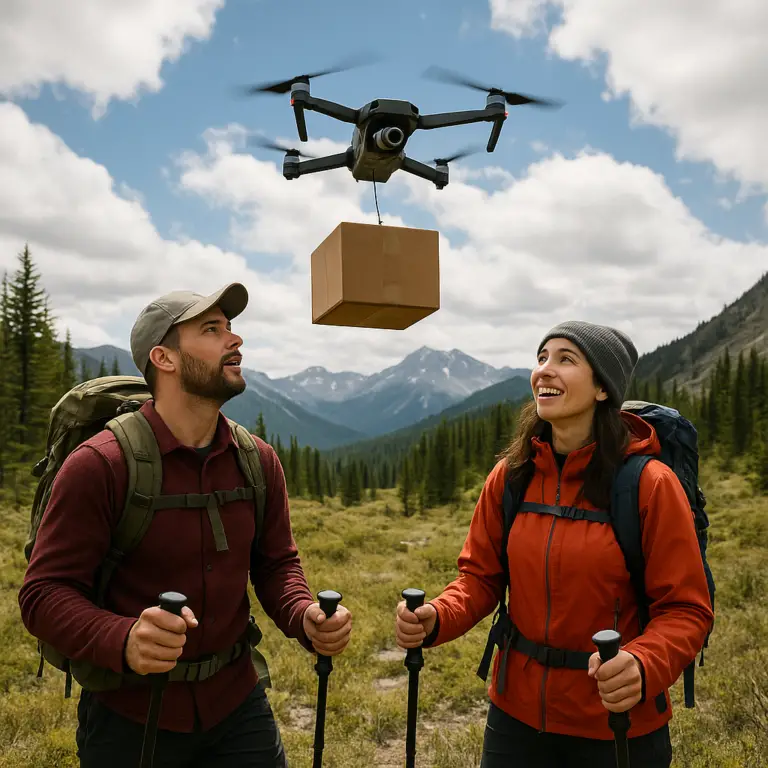
Can you imagine ordering a pizza and having it delivered by a drone in 15 minutes? It sounds like science fiction, but companies like Amazon and Wing (a subsidiary of Alphabet) are making it a reality.
The Challenge of the “Last Mile”
The “last mile” of delivery is the most expensive and time-consuming part of the supply chain. Drones offer a solution bypassing traffic and delivering directly to doorsteps or designated landing pads.
Current Limitations and Hurdles
- Payload Capacity: Most delivery drones are limited to small packages (under 5 lbs).
- Range: Battery life restricts them to a one-hour radius in many cases.
- Regulatory Hurdles: BVLOS operations are strictly regulated to ensure safety in populated areas.
The Future of Air Taxis
The same technology powering package delivery is being adapted for Urban Air Mobility (UAM). Imagine air taxis shutling commuters across congested cities. While still in the testing phase, companies like Joby Aviation and EHang are leading the charge.
SHOP Delivery Drones on:
- Wing Drones: Wing Official
- Zipline Medical Delivery: Zipline Official
🔥 Wildfire Mitigation: How Drones Are Fighting Fire from Above
Wildfires are becoming more frequent and intense. Traditional firefighting is dangerous and often reactive. Drones are changing the game by providing real-time intelligence and even active suppression.
Early Detection and Monitoring
Drones equipped with thermal imaging can spot hotspots before they become full-blown fires. They can fly into smoke plumes that would be lethal for human pilots, mapping the fire’s perimeter and intensity.
Active Supression
Researchers, including teams led by Professor Mrinal Kumar at Ohio State, are developing drones capable of dropping fire retardants or even extinguishing small fires directly.
- Safety: These drones can operate in conditions where helicopters cannot, reducing the risk to human crews.
- Collision Avoidance: Advanced “detect and avoid” radar systems ensure these drones don’t collide with firefighting aircraft.
Case Study: The 2017 Puerto Rico Hurricane
While not a wildfire, the use of drones to restore mobile cellphone towers in Puerto Rico after Hurricane Maria demonstrated their critical role in disaster relief. Drones served as temporary airborne cell towers, restoring communication for thousands of stranded residents.
🚑 First Response: Emergency Services and Search & Rescue Operations
When seconds count, drones are the first on the scene.
Rapid Assessment
Firefighters and EMTs can deploy a drone in minutes to assess a scene—whether it’s a car accident, a building collapse, or a missing person in the woods. This situational awareness allows for better resource allocation.
Search and Rescue (SAR)
- Thermal Imaging: Drones can detect body heat in dense forests or at night, finding missing hikers or children much faster than ground teams.
- Scent Tracking: Emerging technology involves drones equipped with sensors that can track specific scents, acting like a mechanical bloodhound.
Medical Supply Delivery
In remote areas, drones are delivering blood, vaccines, and organs. Zipline has been a pioneer here, delivering life-saving medical supplies to rural clinics in Africa and beyond.
📡 Connectivity Boosters: Mobile Cellphone Towers and Remote Internet Access
Disasters often knock out ground infrastructure. Drones are stepping in as High-Altitude Pseudo-Satellites (HAPS).
Temporary Airborne Towers
Companies like Lon (formerly Google X) and Facebook’s Ascenta acquisition have explored using solar-powered drones to beam internet to remote areas.
- Endurance: These drones can stay aloft for weeks or even months, providing continuous coverage.
- Disaster Relief: As seen in Puerto Rico, they can restore communication networks within hours of a catastrophe.
The Future of Global Connectivity
The goal is to provide universal internet access to the unconnected billions. While some projects have faced challenges, the technology remains a viable solution for bridging the digital divide.
⛈️ Severe Storm Analysis: Meteorological Data Collection and Safety
Meteorologists have long dreamed of flying directly into a tornado. Drones are finally making this possible.
Into the Eye of the Storm
Scientists are developing huricane-hunting drones capable of withstanding extreme winds and turbulence. These drones collect data on pressure, temperature, and humidity from inside the storm, leading to more accurate forecasts.
Improved Safety
By sending drones instead of manned aircraft, we eliminate the risk to pilots. This data is crucial for predicting storm paths and intensity, potentially saving thousands of lives.
🪐 Surveying Other Planets: Extraterestrial Exploration and Mars Rovers
Drones aren’t just for Earth. They are our eyes and ears on other worlds.
NASA’s Ingenuity
The Ingenuity helicopter on Mars has been a game-changer. Since 2021, it has completed 61 flights in the thin Martian atmosphere, proving that powered flight is possible on other planets.
- Technology: It uses lightweight materials and advanced autonomous navigation to fly without real-time control from Earth.
The Future: Titan and Beyond
NASA is planning to send Dragonfly, a drone to the Saturn moon Titan, in 2027. Titan has a thick atmosphere and liquid methane lakes, making it an ideal environment for drone exploration.
- Scientific Impact: These drones will help us understand the potential for life on other worlds.
📸 Aerial Photography and Cinematography: Beyond the Selfie Stick
While this is the most well-known use, the technology is evolving rapidly.
8K and Beyond
Modern drones like the DJI Mavic 3 Pro and Autel Evo II are capturing 8K video and 48MP photos. The quality is indistinguishable from professional cinema cameras.
Autonomous Filmmaking
AI is enabling drones to follow subjects automatically, execute complex camera moves, and even edit footage in real-time. This democratizes high-end filmmaking.
SHOP Aerial Drones on:
- DJI Mavic 3 Pro: Amazon | DJI Official
- Autel EVO II Pro V3: Amazon | Autel Official
🦌 Wildlife Conservation: Monitoring Endangered Species Without Disturbance
Conservationists are using drones as eco-wariors.
Anti-Poaching
Thermal cameras allow rangers to detect poachers at night, protecting endangered species like rhinos and elephants.
- Success Story: The Imageomics Institute uses AI to analyze drone imagery, tracking animal populations and health without disturbing them.
Habitat Monitoring
Drones map deforestation, track migration patterns, and monitor coral reefs. They provide data that is impossible to gather from the ground.
🗺️ Topographic Scanning: LiDAR, Mapping, and Construction Site Management
LiDAR (Light Detection and Ranging) technology on drones is revolutionizing surveying.
3D Mapping
Drones can create highly accurate 3D models of terrain, buildings, and infrastructure. This is essential for:
- Construction: Monitoring progress, calculating earthwork volumes, and ensuring safety.
- Mining: Assessing stockpiles and planning excavation.
- Disaster Management: Creating maps of flood zones or landslide areas.
Safety in Hazardous Areas
Surveying dangerous areas like avalanche zones or unstable cliffs is now safe and efficient.
🏗️ Infrastructure Inspection: Bridges, Power Lines, and Wind Turbines
Inspecting infrastructure manually is dangerous, expensive, and time-consuming. Drones are the solution.
Visual and Thermal Inspection
Drones can inspect bridges, power lines, and wind turbines for cracks, corrosion, or heat loss.
- Efficiency: A drone can inspect a wind turbine in 20 minutes, a task that takes hours for a human climber.
- Data: High-resolution images and thermal data are analyzed by AI to detect defects.
Cost Savings
The energy sector could save $50 billion annually by 2025 through drone inspections, according to industry estimates.
🏭 Industrial Automation: Warehouse Management and Inventory Control
Inside the warehouse, drones are becoming the ultimate inventory managers.
Automated Inventory
Drones fly through aisles, scanning barcodes and RFID tags to update inventory levels in real-time.
- Accuracy: They eliminate human error and provide a complete picture of stock levels.
- Speed: They can count thousands of items in a fraction of the time it takes a human team.
Safety
They can access high shelves and dangerous areas without putting workers at risk.
🚦 Regulatory Landscapes: FAA, EASA, and the Path to Full Autonomy
As drones become more common, regulations are catching up.
BVLOS and Remote ID
The FA and EASA are working on rules for Beyond Visual Line of Sight (BVLOS) operations and Remote ID (a digital license plate for drones).
- Remote ID: Requires drones to broadcast their location and identity, enhancing safety and accountability.
- BVLOS: Essential for delivery and inspection, but requires robust detect and avoid systems.
The Path to Full Autonomy
The ultimate goal is fully autonomous operations where drones can navigate complex urban environments without human intervention. This requires significant advancements in AI, sensor fusion, and communication networks.
🤖 AI and Machine Learning: The Brains Behind the Future of Drone Applications
AI is the engine driving the future of drones.
Autonomous Navigation
AI algorithms allow drones to navigate complex environments, avoid obstacles, and make decisions in real-time.
- Swarm Technology: AI enables drones to work together in swarms, coordinating actions like bees without colliding.
Data Analysis
AI can process the massive amounts of data collected by drones, identifying patterns and anomalies that humans might miss.
🔋 Battery Tech and Range: Overcoming the Power Limitations
Battery technology is the Achilles’ heel of the drone industry.
Current Limitations
Most drones are limited to 20-40 minutes of flight time. This restricts their range and payload capacity.
Future Solutions
- Hydrogen Fuel Cells: Offering longer flight times and faster refueling.
- Solar Power: Enabling drones to stay aloft for days or weeks.
- Lithium-Sulfur: Promising higher energy density than current lithium-ion batteries.
🛡️ Privacy, Security, and Ethical Concerns in the Age of Aerial Surveillance
With great power comes great responsibility. The rise of drones raises significant privacy and security concerns.
Surveillance Fears
The ability of drones to fly over private property and capture high-resolution images has sparked debates about surveillance and civil liberties.
- Regulation: Laws are being developed to protect privacy, such as restrictions on flying over private property without consent.
Security Risks
Drones can be used for malicious purposes, such as smuggling, espionage, or even attacks.
- Counter-Drone Technology: Development of systems to detect and neutralize rogue drones is a growing industry.
Ethical Considerations
As drones become more autonomous, questions arise about accountability and decision-making. Who is responsible if an autonomous drone causes harm?
📰 Related News: Latest Breakthroughs in Drone Technology
The drone industry is moving at breakneck speed. Here are some of the latest headlines:
- New Battery Tech: Breakthroughs in solid-state batteries promise to double flight times.
- Urban Air Mobility: Major cities are testing air taxi services.
- AI Integration: New AI models are enabling more complex autonomous missions.
Stay tuned to Drone Brands™ for the latest updates!
🍪 About Cookies
We use cookies to enhance your experience on our site. By continuing to browse, you agree to our use of cookies.
🔒 Privacy Preference Center
Manage your cookie preferences here.
🧐 What are Cookies?
Cookies are small text files stored on your device that help websites remember your preferences and improve your browsing experience.
🚫 Strictly Necessary Cookies
These cookies are essential for the website to function and cannot be switched off.
📊 Performance Cookies
These cookies help us understand how you use our website so we can improve it.
⚙️ Functional Cookies
These cookies allow the website to remember choices you make (such as your user name, language, or the region you are in) and provide enhanced, more personal features.
🎯 Targeting Cookies
These cookies may be set through our site by our advertising partners to build a profile of your interests and show you relevant adverts on other sites.
📋 Cookie List
A full list of cookies used on our site is available in our privacy policy.
🏁 Conclusion

So, where does this leave us? We started this journey wondering if drones were just a fleeting fad. The answer is a resounding no. From the fields of Belize to the red dust of Mars, from fighting wildfires to delivering life-saving medicine, drones are fundamentally reshaping our world.
The future of drone applications is not just about flying higher or faster; it’s about smarter, safer, and more integrated systems. The challenges of battery life, regulation, and privacy are real, but the innovations in AI, battery technology, and autonomous navigation are rapidly overcoming them.
Our Verdict:
- For Businesses: The ROI is undeniable. Whether it’s infrastructure inspection, agriculture, or logistics, drones offer efficiency and safety that traditional methods cannot match.
- For Consumers: The era of the “smart home” drone is coming, offering everything from security to entertainment.
- For the Planet: Drones are proving to be powerful tools for conservation and climate monitoring.
The sky is no longer the limit; it’s the new frontier. As we move forward, the key will be balancing innovation with responsibility. The drones of tomorrow will be our partners in solving some of the world’s most pressing challenges. Buckle up, because the future is flying!
🔗 Recommended Links
Ready to take flight? Here are some top picks for the gear and resources you need:
👉 Shop Top Drones on:
- DJI Mavic 3 Pro: Amazon | DJI Official
- Autel EVO II Pro V3: Amazon | Autel Official
- Skydio 2+ (Best for AI Obstacle Avoidance): Amazon | Skydio Official
Recommended Books:
❓ FAQ

Are consumer drones becoming safer for urban environments?
Yes. Advances in obstacle avoidance sensors, AI-driven navigation, and Remote ID regulations are making consumer drones significantly safer for urban flight. However, full autonomy in dense cityscapes still requires further regulatory and technological maturity.
Read more about “Top 6 Drone Brands with Advanced Obstacle Avoidance Systems (2026) 🚁”
What new industries are adopting drone technology?
Beyond agriculture and photography, construction, insurance, ming, logistics, and healthcare are rapidly adopting drones for inspection, delivery, and data collection.
Read more about “🚀 7 Explosive Drone Trends & Stats (2026)”
Will drones replace helicopters for emergency rescue missions?
Partially. Drones are already replacing helicopters for initial scene assessment and search and rescue in difficult terrain due to their lower cost and safety. However, for heavy-lift rescue operations (like hoisting survivors), helicopters remain essential for now.
Read more about “Top 6 Drone Brands for Public Safety & Law Enforcement (2026) 🚓”
What are the latest regulations for commercial drone use in 2024?
Regulations vary by country, but key trends include mandatory Remote ID, stricter BVLOS requirements, and increased focus on airspace integration. Always check with your local aviation authority (e.g., FAA in the US, EASA in Europe) for the latest rules.
Read more about “🚀 Drone Business License: Your 2026 Guide to Flying for Profit”
How will drones change the future of aerial photography?
Drones will enable 8K+ video, 3D mapping, and automated cinematic shots that were previously impossible or prohibitively expensive. AI will handle the flying, allowing photographers to focus on composition.
Read more about “🚁 Best Drone Brands of 2026: The Ultimate Guide to Top Picks”
Will drone swarms be used for immersive entertainment or light shows in the future?
Absolutely. Drone light shows are already replacing fireworks in many places due to their precision and environmental friendliness. Future swarms will create interactive, 3D immersive experiences.
What role will autonomous drones play in future aerial adventures and expeditions?
Autonomous drones will act as scouts and cameramen for explorers, mapping unknown terrain and capturing footage without the need for a dedicated pilot, allowing adventurers to focus on the journey.
How will drones contribute to search and rescue efforts in challenging adventure environments?
Equipped with thermal imaging and AI, drones can locate missing persons in dense forests, mountains, or at sea much faster than human teams, significantly increasing survival rates.
What new recreational and leisure activities will future drones enable?
Expect drone racing leagues, augmented reality games, personalized aerial photography services, and even drone-assisted hiking where drones carry gear or provide real-time navigation.
Can drones deliver essential gear to remote adventure sites in the coming years?
Yes. Companies are already testing drone delivery of medical supplies, food, and equipment to remote locations, reducing the need for risky ground transport.
What advanced drone technologies will enhance future aerial photography and videography?
8K sensors, AI stabilization, autonomous flight paths, and swarm coordination will allow for cinematic shots that were previously impossible, even for professional crews.
Read more about “🚀 25 Future Drone Ideas That Will Change the World (2026)”
How will drones revolutionize outdoor exploration and adventure travel?
Drones will provide real-time mapping, safety monitoring, and immersive documentation of remote locations, making exploration safer and more accessible for everyone.
📚 Reference Links
- Ohio State University: Future Uses of Drones
- Futurist Speaker: 192 Future Uses for Flying Drones
- Zuken US: What’s the Future of Drone Technology?
- NASA: Ingenuity Mars Helicopter
- DJI: Official Website
- FA: Remote ID
- Zipline: Medical Delivery
- Imageomics Institute: Wildlife Conservation