Support our educational content for free when you purchase through links on our site. Learn more
🌙 Legal Night Drone Flights: Where You Can Fly in 2026

Legal night drone flight locations and requirements depend on three things: the airspace, permission to use your launch site, and whether your flight meets the rules for your type of operation. In the United States, Part 107 pilots can generally fly at night without a blanket night waiver, but they must meet training and anti-collision lighting requirements—and still follow all other FAA rules.
We’ve learned to scout night-flight locations in daylight. On one evening flight, a wire that was easy to spot before sunset vanished against the dark tree line from a different viewing angle. The lesson: a legal location is only a good location if you can safely see, control, and land your drone there.
Key Takeaways
- Check the exact location before every flight: Airspace approval, park or land-manager rules, and permission to use a launch site are separate requirements.
- Part 107 night flights generally do not need a blanket night waiver, but pilots must meet current training and lighting rules.
- Part 107 anti-collision lights must be visible for at least 3 statute miles and flash at a rate sufficient to avoid a collision.
- Night flying does not waive VLOS, altitude, right-of-way, or controlled-airspace rules.
- Public land is not automatically drone-friendly: Check park hours, launch-and-landing rules, wildlife restrictions, and local requirements.
- Scout hazards and plan conservatively. Wires, trees, glare, fog, and reduced depth perception can make familiar spots risky after dark.
Table of Contents
- ⚡️ Quick Tips and Facts: Legal Night Drone Flights at a Glance
- 🌙 Background: How Drone Night-Flight Rules Changed
- 🧭 What Counts as a Night Drone Flight?
- 🇺🇸 FAA Night-Flying Rules for Drones in the United States
- Recreational Drone Flights After Dark
- Part 107 Night Operations for Commercial Pilots
- Remote Pilot Certificate, Recency, and Training Requirements
- Drone Registration and Remote ID at Night
- 📍 Legal Night Drone Flight Locations: Where You Can Fly
- Public Parks, Beaches, and Open Spaces
- Private Property and Permission to Take Off or Land
- National Parks, Wildlife Areas, and Protected Land
- Cities, Neighborhoods, and Events
- State, Local, and Tribal Drone Restrictions
- 🗺️ Airspace, No-Fly Zones, and Night Flight Authorization
- How to Read a Sectional Chart for Night Drone Flights
- LANC, FAA DroneZone, and Controlled Airspace
- Temporary Flight Restrictions and Security-Sensitive Locations
- How to Check a Location Before You Launch
- 💡 Anti-Collision Lights: Visibility, Color, and Requirements
- FAA Lighting Rules for Night Operations
- Choosing and Mounting a Drone Strobe Light
- Keeping the Drone in Sight After Dark
- 🛡️ Night Drone Safety: Planning, People, and Property
- Preflight Checklist for a Legal Night Flight
- Avoiding People, Buildings, Roads, and Other Aircraft
- Visual Observers, Crew Communication, and Lost-Link Plans
- Battery, Compass, and Sensor Challenges in the Dark
- 🌦️ Night Weather and Visibility: Reading METARs and Forecasts
- How to Read a METAR Before a Night Flight
- Wind, Fog, Clouds, Temperature, and Dew
- When to Cancel a Night Drone Mission
- 🌍 Night Drone Laws Outside the United States
- Checking Your Country’s Aviation Authority Rules
- Cross-Border Travel and Local Drone Restrictions
- 🚫 Common Night-Flying Mistakes and Their Consequences
- 📋 Night Drone Flight Planning Checklist
- ✅ Conclusion
- 🔗 Recommended Links
- ❓ FAQ: Legal Night Drone Flight Locations and Requirements
- Can you legally fly a drone at night in the United States?
- Do recreational drone pilots need a night waiver?
- What lights are required for a drone at night?
- Can you fly a drone at night over private property?
- Can you fly a drone at night in a public park or national park?
- Do you need airspace authorization for a night flight?
- How do you find legal night drone flight locations near you?
- 📚 Reference Links
⚡️ Quick Tips and Facts: Legal Night Drone Flights at a Glance
In the United States, night flying is allowed, but “it’s dark and the drone has lights” is not a complete flight plan. You still need the right pilot qualification, compliant anti-collision lighting where required, legal airspace access, and a location where takeoff and landing are permitted.
Our first stop is the broader guide to where you can fly a drone, because a legal night flight depends on both aviation rules and the rules governing your launch site.
| Quick fact | What it means in practice |
|---|---|
| Night has a legal definition | Under 14 CFR §1.1, night is the period between the end of evening civil twilight and the beginning of morning civil twilight, as defined using the Air Almanac. |
| Part 107 night flights do not automatically require a waiver | The FAA removed the old blanket night-operation waiver requirement when it updated the rules. Part 107 pilots must meet the current night-training and lighting requirements in 14 CFR §107.29. |
| The anti-collision light is a performance requirement | For Part 107 night operations, the light must be visible for at least 3 statute miles and flash at a rate sufficient to avoid a collision. The regulation does not prescribe one specific brand, color, mounting position, or published numerical flash rate. |
| Recreational pilots follow a different route | Recreational flyers must comply with 49 USC §44809 and applicable FAA rules. The FAA’s recreational flyer guidance and TRUST training are good starting points. |
| Airspace authorization can still be required at night | Night does not turn controlled airspace into unrestricted airspace. Check FAA UAS Facility Maps and use an FAA-approved LANC service provider where available. |
| The FAA does not publish a nationwide list of “approved night locations” | A location’s legality depends on airspace, site access, land-management rules, and the details of the operation. |
| VLOS still matters | A bright strobe helps other aircraft spot your drone; it does not replace the requirement to maintain visual line of sight under 14 CFR §107.31. |
Pilot perspective: We plan night flights backwards from the landing point. First, can we legally use the site? Second, can we access the airspace? Third, can we keep the aircraft visible and controlled? Only then do we think about the pretty lights and cinematic shot. That order has saved us from arriving at a scenic launch spot and discovering the ground rules had other ideas. 🌙
🌙 Background: How Drone Night-Flight Rules Changed

For years, commercial drone night operations generally meant applying for a waiver. The FAA changed that framework in 2021, allowing routine Part 107 night operations without a waiver when pilots meet the updated requirements. The current rule is written in 14 CFR §107.29; the FAA’s night operations guidance explains the broader regulatory changes.
As Drone Pilot Ground School summarizes, “you no longer need to apply for the Part 107.29 Daylight Operations waiver to fly your drone at night.” That statement is useful, but it needs a qualifier: the old blanket waiver is gone; the operating requirements are not. A specific operation that cannot comply with the rule may still need a waiver or other FAA approval.
This is where some online guides appear to disagree. One may say “no waiver needed,” while another describes a waiver scenario. Both can be right:
- Routine compliant flight: No night waiver is generally required under current Part 107 rules.
- Operation that cannot meet a required provision: A waiver may be relevant if the FAA permits the proposed deviation.
- Controlled airspace: Airspace authorization is a separate matter, not a substitute for a night waiver.
- Location access: Permission to take off from a park or private parcel is separate from FAA airspace approval.
The FAA’s Part 107 waiver page explains the waiver process. Older night waivers issued under prior rules should not be treated as current blanket permission; check the present regulation and the terms of any specific authorization.
🧭 What Counts as a Night Drone Flight?
The legal term night is not simply “whenever it looks dark.” Under 14 CFR §1.1, night begins at the end of evening civil twilight and ends at the beginning of morning civil twilight, as published in the Air Almanac and converted to local time.
Civil twilight and legal night are often muddled together in casual explanations. Here’s the useful distinction:
| Term | Practical meaning |
|---|---|
| Daylight | The FAA describes the daylight period for Part 107 as beginning 30 minutes before official sunrise and ending 30 minutes after official sunset. |
| Civil twilight | The short transition period around sunrise and sunset. For Part 107 lighting purposes, §107.29 covers operations during civil twilight as well as night. |
| Night | The period after evening civil twilight ends and before morning civil twilight begins, as defined by the Air Almanac. |
Outside Alaska, the Part 107 rule identifies civil twilight as beginning 30 minutes before official sunrise and ending at sunrise, and beginning at sunset and ending 30 minutes after official sunset. Alaska has a separate Air Almanac definition. The exact times shift with date and location, so check an aviation source rather than relying on “about half an hour after sunset.” The U.S. Naval Observatory provides sunrise and sunset data.
A detail worth remembering: the Part 107 anti-collision lighting requirement applies during civil twilight too, not just after full darkness. If you launch at sunset and keep flying through twilight, your lighting obligation does not wait for the sky to turn black.
🇺🇸 FAA Night-Flying Rules for Drones in the United States
Recreational Drone Flights After Dark
Recreational pilots can fly at night in the United States, but the flight must remain genuinely recreational and comply with the applicable rules. The FAA’s recreational flyer page and TRUST information explain the required safety test and operating framework.
For recreational flights:
- Follow the applicable recreational operating rules under 49 USC §44809.
- Complete TRUST and carry proof of completion when flying, as explained by the FAA.
- Register the drone when required; the FAA’s registration guidance explains which aircraft must be registered.
- Check airspace and obtain any required authorization.
- Keep the aircraft within visual line of sight and yield right of way to other aircraft.
- Follow any applicable lighting, site-access, and local restrictions.
A recreational pilot flying a drone for a client, business, or other non-recreational purpose should not assume the flight qualifies as recreational just because the aircraft is small. Commercial purpose usually points toward Part 107; see the FAA’s Part 107 overview.
Part 107 Night Operations for Commercial Pilots
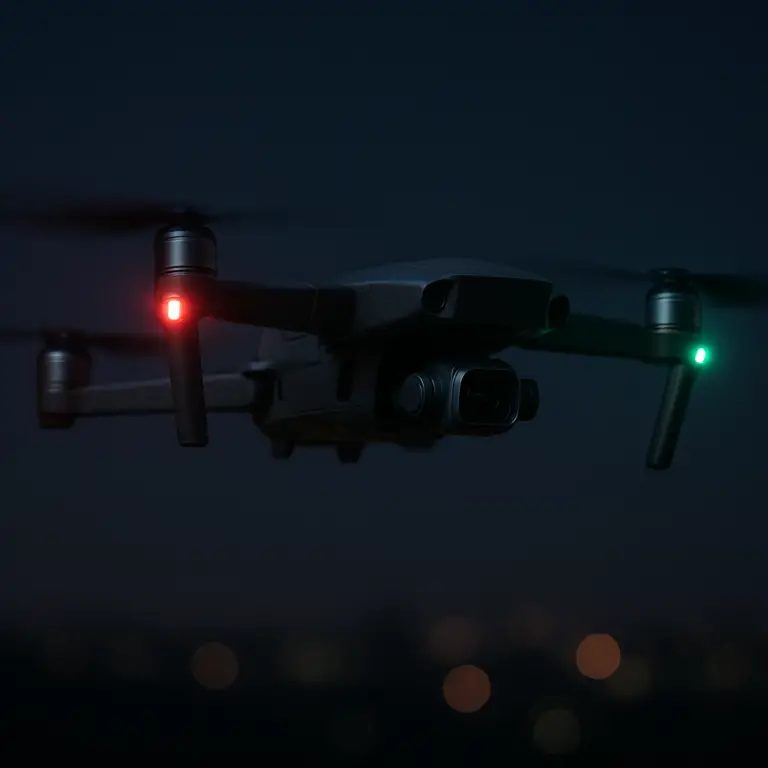
Under Part 107, the remote pilot in command must ensure the aircraft has lighted anti-collision lighting visible for at least 3 statute miles, with a flash rate sufficient to avoid a collision, during night operations and civil twilight. That is the core requirement in 14 CFR §107.29.
The rule is performance-based:
- The FAA does not specify one required light color, product, or mounting point.
- A solid navigation light alone does not satisfy the rule’s flashing anti-collision requirement.
- You may use an aircraft’s built-in light if it meets the rule in the actual operating conditions.
- If it does not, an aftermarket strobe may be needed.
- The remote pilot remains responsible for confirming the light works and is sufficiently visible.
- If reduced intensity is appropriate for safety, the rule permits diming, but not switching the required anti-collision light off.
The FAA’s Part 107 night-operations rule and §107.29 text take priority over a product’s marketing claim. A label saying “visible for miles” is not a substitute for checking the light’s specifications, mounting, battery, and performance at your site.
Part 107 pilots must also comply with the rest of the operating rules, including visual line of sight, altitude limits, right of way, weather limitations, and controlled-airspace authorization. A night strobe does not grant permission to fly above the usual limit or into restricted airspace.
Remote Pilot Certificate, Recency, and Training Requirements
Part 107 pilots need the applicable night-operations knowledge or training. The FAA incorporated night-operation topics into its certification and recurrent training framework. Pilots who earned their certificate before the updated requirements should check their training record and complete the current FAA training required for their situation.
Use these FAA resources rather than relying on an old forum post:
Night training addresses more than a multiple-choice question about strobe lights. It covers reduced visual cues, aircraft orientation, obstacles, night physiology, and the limitations of human vision. You do not need a separate night-vision medical test simply because you fly after dark, but you must not act as remote pilot or visual observer if a known condition prevents safe performance under 14 CFR §107.17.
Drone Registration and Remote ID at Night
Nightime does not create a special registration category. The same aircraft registration and marking rules apply as during daylight. Check the FAA’s drone registration page to determine whether your aircraft must be registered.
Remote ID is also a separate compliance question. The FAA generally requires registered drones to comply with Remote ID unless an applicable exception or authorized operating area applies. See the FAA’s Remote ID guidance. A Remote ID signal is not anti-collision light, and anti-collision strobe is not Remote ID. They do different jobs.
Before launching, verify:
- Registration is current and markings are present where required.
- The aircraft’s Remote ID status meets the applicable rule.
- Any FAA-recognized identification area exception actually applies to your operation.
- Lighting and airspace authorization requirements are independently satisfied.
📍 Legal Night Drone Flight Locations: Where You Can Fly
There is no universal FAA directory of “legal places to fly at night.” A location can be lawful from an aviation perspective but unavailable for takeoff, landing, or operation because of land-manager rules. Conversely, public access does not mean the airspace is unrestricted.
| Location type | What to check before flying |
|---|---|
| Public park or beach | Park rules, operating hours, launch-and-recovery permissions, local restrictions, wildlife protections, and airspace. |
| Private property | Permission to access and use the launch or landing area, privacy and nuisance considerations, airspace, and safe separation from people. |
| National park | National Park Service rules on launching, landing, and operating drones; site-specific exceptions; and airspace. |
| Controlled airspace near an airport | FAA authorization through LANC or another approved process, plus ordinary operating rules. |
| Temporary event or emergency area | Temporary flight restrictions, emergency response activity, event-specific rules, and airspace notices. |
| Uncontrolled airspace | Airspace restrictions, altitude limit, visibility, nearby airports, site access, and hazards. |
The FAA governs the national airspace system, while local authorities and land managers may regulate where people may stand, launch, land, or use property. The exact boundary between aviation regulation and land-use rules can be legally nuanced; don’t treat a general online claim as permission for a specific park or property.
Public Parks, Beaches, and Open Spaces
A public park is not automatically a drone launch site. Some parks allow drone use only in designated areas; others prohibit launching or landing, restrict hours, or require permits. Start with the official park or city website and look for rules covering unmanned aircraft, model aircraft, photography, and after-hours access.
For federal land, check the relevant agency:
- National Park Service drone policy
- U.S. Fish and Wildlife Service unmanned aircraft policy
- U.S. Forest Service aviation guidance
At beaches and open spaces, also look for seasonal wildlife closures, nesting areas, marine mammals, and nighttime access restrictions. A moonlit beach can look empty from the parking lot while serving as a wildlife nursery. Follow posted rules and keep a respectful buffer.
Our field habit: We check the land manager’s website, then call if the rule is unclear. A five-minute phone call is cheaper than a drive home, and considerably less awkward than explaining a strobe to a park ranger.
Private Property and Permission to Take Off or Land
In general, permission to use the ground and permission to use the airspace are different questions. A property owner may control access to their land and may have legitimate concerns about privacy, disturbance, and safety. FAA rules govern aircraft operations in the national airspace system.
For a private-property night flight:
- Get permission to enter and use the property for launch and recovery.
- Check local ordinances and property rules, especially for noise, lighting, privacy, and hours.
- Check airspace and restrictions using FAA resources.
- Plan the route to avoid unnecessary flight over people and neighboring properties.
- Keep camera use proportionate and respectful. Don’t point a camera into windows or use the aircraft to harass or surveil someone.
The FAA’s UAS guidance is the authority for federal drone rules. State and local rules may address privacy, trespass, or land use, but the details vary by jurisdiction. If a dispute involves a particular property or municipal rule, check the actual local law or consult a qualified attorney rather than relying on a broad social-media claim.
National Parks, Wildlife Areas, and Protected Land
The National Park Service generally prohibits launching, landing, or operating drones from NPS-administered lands and waters except under specific authorization or exceptions. Read the agency’s official unmanned aircraft policy before planning a national-park night flight.
Other protected areas may have their own rules. Wildlife disturbance is a particular concern at night: animals can be more vulnerable when resting, nesting, or feeding, and a drone’s lights and sound may cause disturbance even when the aircraft is legally flown.
Before flying near protected land:
- Identify the land manager and the exact boundary.
- Read current rules and temporary closures.
- Avoid wildlife, rosts, nesting sites, and conservation areas.
- Do not assume that flying over a site is permitted just because launch occurs outside its boundary.
- If the mission is for public safety, research, or agency work, obtain the required permission or authorization before launch.
Cities, Neighborhoods, and Events
Urban night flights add complexity: controlled airspace, streetlights, reflective glass, people, traffic, and a steady supply of things that look like safe landing spots until they are not. Check the city’s rules for launch and landing areas, park hours, special permits, and event restrictions.
Part 107 pilots must also follow rules on operations over people and moving vehicles. The FAA’s Operations Over People guidance explains categories and conditions. A nighttime flight does not exempt you from those requirements.
At concerts, stadiums, parades, and other events, look for FAA restrictions and event-specific notices. Check current Temporary Flight Restrictions and official event information. Never assume that a public event is fair game because you can see it from a nearby rooftop.
State, Local, and Tribal Drone Restrictions
State and local rules can address matters such as privacy, trespass, takeoff and landing locations, park access, and public safety. Tribal lands may have separate access and permitting requirements. Since laws vary, verify the rules for the exact jurisdiction and parcel.
A practical source-checking order:
- FAA airspace and operating rules.
- Official state statutes or agency guidance.
- City, county, park, or land-manager rules.
- Tribal government policies where relevant.
- Property owner permission for private launch and recovery sites.
Legal summaries can be useful starting points, but statutes and official agency rules are the better sources when they conflict. For broader pilot resources, browse our Drone Brand Guides and Drone Accessories categories.
🗺️ Airspace, No-Fly Zones, and Night Flight Authorization
Night operations use the same airspace framework as daytime operations. Darkness does not grant extra altitude, airport access, or permission to enter restricted areas.
Part 107 operations are generally limited to 400 feet above ground level, subject to the specific regulatory exceptions and conditions in 14 CFR §107.51. Recreational flyers must follow the applicable altitude and airspace rules under 49 USC §44809.
How to Read a Sectional Chart for Night Drone Flights
Sectional charts help pilots understand airports, airspace classes, and other aviation information. They are useful, but they are not a standalone night-flight permission slip. For current digital airspace restrictions and authorization requirements, use FAA tools and current notices.
The FAA’s Aeronautical Chart User’s Guide explains chart symbols. To prepare:
- Identify your launch location and nearby airports.
- Determine the airspace class and any ceiling or authorization requirement.
- Check chart notes and special-use airspace.
- Check current TFRs and notices.
- Confirm your planned altitude and route meet the applicable rules.
- Recheck close to launch; airspace conditions can change.
LANC, FAA DroneZone, and Controlled Airspace
Flights in controlled airspace may require prior authorization. The FAA’s LANC program allows eligible pilots to request authorization through FAA-approved service providers in participating areas. Applications that cannot be handled through LANC may need to be submitted through FAA DroneZone.
Keep the concepts separate:
| Item | What it authorizes or addresses |
|---|---|
| Night training and lighting compliance | Whether you meet night-operation requirements. |
| LANC or DroneZone authorization | Whether the operation is authorized in relevant controlled airspace, subject to its terms. |
| Park or property permission | Whether you may access and use the launch or landing location. |
| Waiver | Permission to deviate from a particular Part 107 rule, if the FAA grants it. |
An airspace authorization is not a waiver, and neither one overrides park rules or property access restrictions. Read the authorization carefully for altitude, location, and time limits.
Temporary Flight Restrictions and Security-Sensitive Locations
Check the FAA’s live TFR map before each flight. Temporary restrictions can be issued for emergencies, VIP movements, major events, or other safety and security reasons. Night flights around fire scenes, search-and-rescue activity, and law-enforcement operations require particular caution: responders may already be operating aircraft, sometimes in low visibility.
If emergency aircraft are nearby, land and stay clear unless you are part of the authorized response. Your drone’s strobe does not make it safe to share a small patch of sky with a helicopter crew that is busy saving lives.
How to Check a Location Before You Launch
Use this sequence every time, even if you flew the same site last week:
- Pin the exact launch point. A nearby street address can place you in a different airspace grid.
- Check airspace and authorization. Use FAA UAS tools, an approved LANC provider, and current notices.
- Check the land manager’s rules. Confirm access hours and drone policies.
- Check weather and visibility. Review a current forecast and nearby aviation weather observations.
- Scout hazards in daylight when possible. Locate power lines, tree limbs, reflective surfaces, and safe landing areas.
- Check people and aircraft activity. Look for events, emergency response, agricultural operations, and nearby heliports.
- Set a conservative route and altitude. Avoid unnecessary overflight of homes, roads, and people.
- Make a go/no-go decision at the site. If visibility, lighting, access, or airspace status is unclear, postpone.
💡 Anti-Collision Lights: Visibility, Color, and Requirements
FAA Lighting Rules for Night Operations
For Part 107 night operations and civil twilight, 14 CFR §107.29 requires lighted anti-collision lighting visible for at least 3 statute miles, with a flash rate sufficient to avoid a collision.
The rule does not prescribe a particular color or specific commercial product. That flexibility is helpful, but it puts responsibility on the remote pilot. As Rupprecht Law’s regulatory analysis emphasizes, the pilot remains responsible for verifying the light is operational and visible for three miles in the operating conditions.
A few distinctions matter:
- Anti-collision light: Flashing or strobing light intended to make the aircraft conspicuous to other aircraft.
- Navigation or position light: A steady light that can help show orientation; it does not automatically meet the anti-collision requirement.
- Pilot-facing orientation light: Helpful for recognizing the drone’s heading, but not necessarily a compliant anti-collision light.
- Built-in drone LEDs: Useful if they meet the legal performance standard; don’t assume they do.
The regulation does not state a numeric flash-rate threshold for drone lights. References to obstruction-lighting standards can provide context, but they are not a separate drone-specific flash-rate rule. Follow the actual text of §107.29 and the FAA’s current guidance.
Choosing and Mounting a Drone Strobe Light
When comparing lights, look beyond the word “bright.” A compliant product should have clear manufacturer specifications for visibility and flashing operation, and it must work reliably in the way you mount it.
Consider:
| Feature | Why it matters |
|---|---|
| Documented visibility | Look for manufacturer-stated visibility of at least three statute miles; then consider haze, mist, and background lighting at your site. |
| Flashing mode | A flashing anti-collision mode is needed for Part 107’s performance requirement; a solid-only light is not enough. |
| Attachment security | A loose mount can block the light, vibrate, or detach in flight. |
| Weight and balance | Extra accessories can affect flight time and handling, especially on small aircraft. |
| Battery and runtime | The light must remain on for the entire operation and be checked before takeoff. |
| Visibility from multiple angles | The aircraft’s shape, arms, battery, and camera may obstruct a light from some viewpoints. |
| Dimming options | Helpful if glare or operating conditions make reduced intensity safer; do not extinguish the required light. |
| Compatibility with other operations | Bright strobes may affect nearby pilots using night-vision equipment. Coordinate when working around other aircraft or crews. |
Commonly discussed brands include Lume Cube and Firehouse Technology. These are examples, not FAA endorsements. Check the specific model’s current technical information; product availability, specifications, and claims can change.
The featured video’s perspective is practical: it recommends a strobing anti-collision light and discusses the Lume Cube strobe. That advice aligns with the need for a flashing light, but a video recommendation or discount code is not regulatory verification. Confirm the exact model meets the standard and suits the aircraft.
Keeping the Drone in Sight After Dark
A strobe helps other aircraft see your drone; it does not guarantee that you can maintain visual line of sight. Night lighting can make distance and orientation harder to judge. A bright point in the sky may be visible while the drone’s position, heading, and movement remain ambiguous.
To keep the aircraft in sight:
- Use orientation lights in addition to the required anti-collision light when helpful.
- Keep the operating area small enough to see the aircraft and determine its direction.
- Avoid flying toward bright city lights, reflective windows, or a low moon.
- Use a trained visual observer when the operation benefits from one, with clear communication.
- Do not use the camera feed as a replacement for VLOS.
- Land if haze, glare, or distance makes visual tracking unreliable.
A visual observer is not automatically required for Part 107 night flight, but can be a valuable safety aid. The FAA’s rules still require the remote pilot to maintain control and comply with VLOS provisions.
🛡️ Night Drone Safety: Planning, People, and Property
Night flying turns familiar terrain into a different place. A tree that was obvious at noon can disappear against a dark sky; a streetlight can make a safe route look clear while hiding wires. We treat the preflight like a rehearsal, not a formality.
Preflight Checklist for a Legal Night Flight
Use this checklist before the aircraft leaves the ground:
- ✅ Pilot: Correct certificate or recreational qualification; required training current.
- ✅ Airspace: Location checked; required authorization obtained and valid.
- ✅ Site: Launch and recovery access permitted; hours and local rules checked.
- ✅ Aircraft: Registration and Remote ID compliance verified where applicable.
- ✅ Lights: Anti-collision light tested, secure, flashing, and supported by manufacturer visibility specifications.
- ✅ Battery: Aircraft, controller, and light batteries charged; return reserve planned.
- ✅ Weather: Wind, visibility, precipitation, temperature, and forecast trends reviewed.
- ✅ Hazards: Wires, trees, towers, cranes, people, traffic, and reflective surfaces identified.
- ✅ Crew: Observer roles and communication signals agreed if an observer is used.
- ✅ Emergency plan: Lost-link, flyaway, low-battery, and forced-landing actions reviewed.
- ✅ Go/no-go: Conditions still safe at the launch site; otherwise, postpone.
The FAA’s UAS safety guidance and aircraft manufacturer manuals should inform your checklist. For aircraft-specific advice, see our drone brand guides and commercial drone resources.
Avoiding People, Buildings, Roads, and Other Aircraft
Part 107 night pilots remain subject to rules about people, moving vehicles, right of way, and visual line of sight. The exact requirements for flying over people depend on the operation and aircraft category; the FAA summarizes them in its Operations Over People guidance.
At night, add wider practical margins:
- Avoid unnecessary overflight of uninvolved people.
- Keep clear of roads and moving vehicles unless your operation satisfies the applicable requirements.
- Stay well away from wires, towers, cranes, and buildings that blend into the darkness.
- Yield to all crewed aircraft and land if one approaches.
- Do not assume a helicopter can see your drone just because your strobe is on.
- Avoid emergency scenes unless you are authorized and coordinated with responders.
Anecdote from the field: On a dusk scouting run, a low cable that had been obvious in daylight vanished against the tree line when our viewing angle changed. We marked it before the actual mission and adjusted the flight path. At night, the best obstacle-avoidance technology is often a daylight site walk.
Visual Observers, Crew Communication, and Lost-Link Plans
A visual observer is not universally required for night operations, but a second set of eyes can help with traffic, obstacle awareness, and orientation. The remote pilot remains responsible for the flight; an observer does not transfer that responsibility.
Before launch, agree on:
- The observer’s position and field of view.
- Simple, unambiguous calls such as “aircraft approaching,” “drone left,” and “land now.”
- How the crew will communicate if radios fail.
- The planned lost-link behavior and return-to-home altitude.
- A specific landing trigger for low battery, poor visibility, or a nearby aircraft.
Check the aircraft’s return-to-home settings before every night mission. A return path set for daytime terrain may be unsafe around wires, cranes, or trees. Do not blindly trust the default: verify its altitude against the actual site and applicable altitude limits.
Battery, Compass, and Sensor Challenges in the Dark
Low light can affect optical obstacle-avoidance systems, vision positioning, and landing sensors. Your drone may fly normally, but night conditions can reduce the reliability of sensors that depend on visible texture or contrast. Review the manufacturer’s manual for your aircraft and confirm which systems are limited in low light.
Practical steps:
- Inspect the landing area with a flashlight before takeoff.
- Avoid relying on vision sensors near featureless pavement, dark water, or reflective surfaces.
- Keep extra battery reserve for a slower approach and landing.
- Watch for cold-weather battery performance changes.
- Confirm compass and GNSS status before launch.
- Use a controlled, conservative descent rather than rushing the landing.
For product-specific maintenance and accessories, browse our drone accessories category. Extra lighting can help with orientation, but it adds weight and can create glare; test the setup in a safe area before a paid or time-critical mission.
🌦️ Night Weather and Visibility: Reading METARs and Forecasts
How to Read a METAR Before a Night Flight
A METAR is a routine aviation weather observation. It can help you assess wind, visibility, clouds, temperature, and other conditions near an airport. The FAA’s Aviation Weather Center provides current METARs, while the National Weather Service explains aviation weather products.
A simple METAR review:
- Find the nearest useful reporting station. It may not reflect conditions at your exact site.
- Check observation time. A stale report may miss changing conditions.
- Read wind direction and speed. Compare them with the aircraft’s operating limits and landing plan.
- Check prevailing visibility. Haze and mist can make a strobe appear bright but obscure the aircraft itself.
- Review cloud layers and ceiling. Stay within applicable rules and maintain a safe margin from clouds and crewed aircraft.
- Compare temperature and dew point. A small spread can signal fog or mist risk.
- Check trends and forecasts. Conditions can deteriorate during the mission.
A METAR is not a guarantee of safety at your launch point. Local terrain, water, buildings, and temperature can create microclimates. Combine the report with direct observation and a current forecast.
Wind, Fog, Clouds, Temperature, and Dew
Night conditions can change faster than your camera settings. Watch for:
- Wind: Buildings and trees can create turbulence that is hard to judge from the ground.
- Fog or haze: Reduces visual line of sight and can scatter light.
- Low cloud: Can obscure the aircraft and create a collision hazard with crewed aircraft.
- Dew and moisture: Can affect cameras, sensors, and electrical components.
- Cold temperatures: May reduce usable battery capacity.
- Glare: Streetlights, headlights, and illuminated buildings can interfere with orientation.
- Precipitation: Can affect visibility, control, and aircraft condition.
The FAA’s Part 107 weather and operating rules include minimum visibility and cloud-clearance requirements. Never treat anti-collision strobe’s three-mile visibility specification as permission to fly when your own VLOS is inadequate.
When to Cancel a Night Drone Mission
Cancel or delay the flight if:
- You cannot maintain visual line of sight.
- The anti-collision light is unreliable or blocked.
- Airspace authorization is missing, expired, or unclear.
- A TFR or emergency operation affects the area.
- Weather is deteriorating or visibility is marginal.
- The launch site is closed or permission is uncertain.
- People or vehicles cannot be safely separated from the operation.
- The aircraft’s sensors, batteries, or return-to-home plan are not suitable for conditions.
- You are tired, distracted, or unable to perform the mission safely.
The shot will still be there tomorrow. A damaged aircraft, privacy complaint, or airspace violation is a much less charming souvenir.
🌍 Night Drone Laws Outside the United States
Night-flying rules vary by country. Do not export FAA requirements to another jurisdiction and assume they apply. Check the national aviation authority, local airspace tools, and land access rules before travel.
| Jurisdiction | General guidance to verify |
|---|---|
| United States | FAA rules allow compliant night operations; Part 107 pilots must meet §107.29, and airspace/site rules still apply. |
| United Kingdom | Check Civil Aviation Authority drone rules for current VLOS and lighting requirements; rules depend on operation category and location. |
| Canada | Check Transport Canada drone rules for night-operation lighting, VLOS, pilot certificate, and airspace conditions. |
| Australia | Check CASA’s drone rules for day/night operating limits, operator requirements, and authorizations. |
Checking Your Country’s Aviation Authority Rules
Before flying abroad:
- Identify the aviation authority for the country and region.
- Check night-specific rules, lighting, VLOS, and pilot competency requirements.
- Check registration, remote identification, and operator registration requirements.
- Confirm controlled-airspace approval procedures.
- Check land access, park rules, wildlife restrictions, and local privacy law.
- Review battery transport rules with your airline.
- Save official guidance or authorization details for offline access.
A foreign country may define “night” differently, require a different light color or arrangement, or prohibit recreational night operations while allowing approved commercial missions. The JOUAV international overview is useful background, but always confirm details with the relevant aviation authority because regulations can change.
Cross-Border Travel and Local Drone Restrictions
Airline approval to carry a drone does not authorize you to fly it. Before packing:
- Review airline and national battery transport requirements.
- Check import, registration, and radio-frequency rules.
- Confirm whether your aircraft’s Remote ID or geofencing features work as expected abroad.
- Check local rules for parks, heritage sites, wildlife areas, and city centers.
- Do not rely on a U.S. FAA authorization outside U.S. jurisdiction.
Our Drone Brand Guides can help with aircraft-specific travel considerations, but local law remains the final word.
🚫 Common Night-Flying Mistakes and Their Consequences
| Mistake | Why it causes trouble | Better move |
|---|---|---|
| Assuming any LED counts as anti-collision light | Solid lights or inadequate visibility may not meet Part 107’s performance requirement. | Check the exact rule and manufacturer specifications. |
| Treating “no waiver required” as “no rules apply” | Pilot training, lighting, airspace, VLOS, and site access still matter. | Review §107.29 and the rest of the operating rules. |
| Assuming the park is open to drones because it is public | Land managers may restrict launching, landing, or after-hours access. | Read official park rules and confirm permission. |
| Using the camera feed as a substitute for VLOS | Remote video does not remove the visual-line-of-sight requirement. | Keep the aircraft visible and within safe operating range. |
| Trusting a daylight scouting memory | Wires, branches, and terrain can disappear in darkness. | Scout in daylight and mark hazards. |
| Forgeting controlled-airspace authorization | Night flights are subject to the same airspace restrictions. | Check current maps and obtain required authorization. |
| Believing a strobe makes the drone easy to orient | A bright light can reveal the aircraft while hiding its heading. | Use suitable orientation lighting and keep the route conservative. |
| Ignoring local wildlife or privacy concerns | Legal airspace use does not excuse disturbance or intrusive filming. | Choose a considerate route and respect people and wildlife. |
| Continuing after visibility deteriorates | A visible light does not mean the pilot can safely maintain VLOS. | Land early when visibility orientation becomes uncertain. |
One recurring source of confusion is the word “location.” A map may show an airspace where flight is possible, but it cannot guarantee that a park is open, a land manager allows launch, or a property owner welcomes your crew. The legal answer comes from checking all three layers: airspace, ground access, and operational safety.
📋 Night Drone Flight Planning Checklist
Use this step-by-step plan for a routine U.S. night mission:
Before choosing the location
- Decide whether the flight is recreational or under Part 107.
- Identify the exact launch and recovery site.
- Check land-manager rules, operating hours, and permission.
- Check airspace, controlled-airspace authorization, and TFRs.
- Confirm the operation fits the applicable altitude, VLOS, and people/vehicle rules.
Before leaving for the site
- Review official sunrise, sunset, and civil-twilight times.
- Check current METARs, forecast wind, visibility, cloud, and precipitation.
- Charge the aircraft, controller, light, and observer communications equipment.
- Review the manufacturer’s low-light and sensor limitations.
- Prepare a conservative route, altitude, return-to-home setting, and landing plan.
At the launch point
- Confirm the site remains open and conditions remain safe.
- Inspect hazards, people, traffic, overhead wires, and nearby aircraft activity.
- Test the anti-collision light and check its attachment and battery.
- Confirm visual line of sight from the pilot’s actual position.
- Brief the observer, if used, and agree on calls and abort triggers.
- Make the go/no-go decision. If any legal or safety requirement is uncertain, do not launch.
During and after the flight
- Maintain VLOS, keep the required light operating, and yield to crewed aircraft.
- Monitor battery, weather, and visibility continuously.
- Land early if the drone becomes difficult to orient or conditions change.
- Record the flight and any authorization details required by your operation.
- Inspect the aircraft and lighting equipment after landing.
The fun part of night flying is the view. The professional part is making sure the view is earned safely and legally.